| Job Title |
What you do |
Typical employer type |
| Financial accountant |
Prepare statutory accounts and manage external audit processes |
Medium and large organisations |
| Management accountant |
Deliver monthly management accounts, budgets and business performance reports |
Private companies, charities and public sector organisations |
| Finance business partner |
Connect financial data to operational decision-making for non-finance stakeholders |
Large companies, NHS bodies, universities and commercial organisations |
| Tax manager |
Lead corporate or personal tax advisory engagements |
Tax advisory firms, accountancy practices and large corporates |
| Internal auditor |
Evaluate internal controls, risk management processes and governance frameworks |
Large companies, public sector organisations and financial institutions |
| Financial controller |
Oversee accounting operations, reporting, compliance and cash management |
Medium and large businesses |
| Compliance analyst |
Review controls, reporting and regulations |
Banks, corporates and advisory firms |
Financial accountant
What you do
Prepare statutory accounts and manage external audit processes
Typical employer type
Medium and large organisations
Management accountant
What you do
Deliver monthly management accounts, budgets and business performance reports
Typical employer type
Private companies, charities and public sector organisations
Finance business partner
What you do
Connect financial data to operational decision-making for non-finance stakeholders
Typical employer type
Large companies, NHS bodies, universities and commercial organisations
Tax manager
What you do
Lead corporate or personal tax advisory engagements
Typical employer type
Tax advisory firms, accountancy practices and large corporates
Internal auditor
What you do
Evaluate internal controls, risk management processes and governance frameworks
Typical employer type
Large companies, public sector organisations and financial institutions
Financial controller
What you do
Oversee accounting operations, reporting, compliance and cash management
Typical employer type
Medium and large businesses
Compliance analyst
What you do
Review controls, reporting and regulations
Typical employer type
Banks, corporates and advisory firms
What Can You Do With a Finance Degree?
A finance degree can lead to careers in four main areas such as investment and capital markets, corporate finance and treasury, financial risk and regulation, and banking and financial services. Finance roles focus on capital allocation, valuation, and market analysis rather than reporting, compliance, and audit. With a finance degree, you can work across banking, insurance, technology, consultancy, wealth management, and corporate finance.
Four primary career pathways with a finance degree are listed below.
- Investment and capital markets: roles including investment analyst, equity researcher and portfolio analyst. They apply the degree's asset valuation, financial modelling, and market analysis modules. Graduates pursuing this pathway often study the CFA (Chartered Financial Analyst) programme, which requires three levels of examination and is the primary professional credential for investment professionals globally.
- Corporate finance and treasury: roles including treasury analyst, M&A analyst and corporate development associate. They apply knowledge of discounted cash flow modelling, capital structure analysis, and financial due diligence. These roles sit within the finance departments of large corporations and within investment banks' advisory divisions.
- Financial risk management: roles including credit risk analyst, market risk analyst, and compliance officer — apply statistical modelling, scenario analysis, and regulatory knowledge (including Basel III and FCA requirements). The FRM (Financial Risk Manager) qualification from GARP supports graduates entering this pathway.
- Financial services and banking: roles including relationship manager, product analyst at a bank, and wealth management associate — apply client-facing finance knowledge and product understanding. These roles exist at retail banks, private banks, and wealth management firms including Barclays, Lloyds, HSBC, and St. James's Place.
A finance degree often leads to commercial roles where data, forecasting and judgement matter.
What Jobs Can You Get With a Finance Degree?
You can get access to ten graduate-level job roles with a finance degree. With a Finance degree a graduate can access ten graduate-level roles across investment, banking, corporate finance, and risk with a finance degree.
The table lists ten graduate and entry-level roles, jobs description and employers.
| Job title |
What you do |
Typical employer type |
| Junior financial analyst |
Build financial models, prepare investment memos, and support due diligence processes |
Corporates, banks, and consultancies |
| Investment banking analyst |
Execute M&A transactions, equity raises, and debt financings under senior supervision |
Investment banks and investment firms |
| Equity research analyst |
Produce investment research reports on listed companies for institutional investors |
Investment banks and brokerage firms |
| Risk analyst |
Quantify credit, market, or operational risk exposures using statistical models and scenario analysis |
Banks, insurers, and large firms |
| Treasury analyst |
Manage corporate cash positions, foreign exchange exposure, and short-term funding requirements |
Public sector organisations, financial institutions, and large corporations |
| Compliance analyst |
Monitor regulatory obligations and report breaches to senior compliance officers |
Banks, law firms, and financial services organisations |
| Wealth management associate |
Support client portfolio construction and financial planning |
Wealth management firms |
| Graduate scheme analyst, banking |
Rotate across retail banking, product, credit, and risk functions over a two- to three-year structured programme |
Retail and commercial banks |
| Actuarial analyst |
Model financial risk for insurance and pension products using probability and statistics |
Banks, insurance companies, and public sector organisations |
| Financial planning analyst |
Contribute to the annual budgeting and forecasting cycle |
Corporate finance teams, corporations, and financial institutions |
Junior financial analyst
What you do
Build financial models, prepare investment memos, and support due diligence processes
Typical employer type
Corporates, banks, and consultancies
Investment banking analyst
What you do
Execute M&A transactions, equity raises, and debt financings under senior supervision
Typical employer type
Investment banks and investment firms
Equity research analyst
What you do
Produce investment research reports on listed companies for institutional investors
Typical employer type
Investment banks and brokerage firms
Risk analyst
What you do
Quantify credit, market, or operational risk exposures using statistical models and scenario analysis
Typical employer type
Banks, insurers, and large firms
Treasury analyst
What you do
Manage corporate cash positions, foreign exchange exposure, and short-term funding requirements
Typical employer type
Public sector organisations, financial institutions, and large corporations
Compliance analyst
What you do
Monitor regulatory obligations and report breaches to senior compliance officers
Typical employer type
Banks, law firms, and financial services organisations
Wealth management associate
What you do
Support client portfolio construction and financial planning
Typical employer type
Wealth management firms
Graduate scheme analyst, banking
What you do
Rotate across retail banking, product, credit, and risk functions over a two- to three-year structured programme
Typical employer type
Retail and commercial banks
Actuarial analyst
What you do
Model financial risk for insurance and pension products using probability and statistics
Typical employer type
Banks, insurance companies, and public sector organisations
Financial planning analyst
What you do
Contribute to the annual budgeting and forecasting cycle
Typical employer type
Corporate finance teams, corporations, and financial institutions
Finance graduates can move into accounting, especially in mixed roles that combine reporting and analysis.
What Do Accounting and Finance Graduates Do?
Accounting and finance graduates usually enter graduate schemes, trainee roles or junior analyst positions. Many graduates also combine employment with professional study towards qualifications such as ACCA, ICAS, CIMA, CIPFA, or ICAEW.
A 2025/2026 report by Prospects and HESA entitled “What do graduates do?” found that the top 10 professional jobs held by first-degree graduates include chartered and certified accountants, and finance and investment analysts and advisers. The same report indicates that 57.5% of Finance and Accountancy graduates were in full-time employment after 15months of graduation, 7.3% were working part-time, 18.1% were working and studying, 2.6% in further study.
Among graduates continuing their education, 64.8% were in further study pursuing Professional qualification like ACCA, CIMA, ICAS etc.
Who employs Accounting and Finance Graduates?
Accounting and finance graduates are employed by 5 categories of employer including Big four accounting firms, large listed companies (FTSE 350 companies), financial institutions, public sector organisations, and SMEs or startups.
- The Big 4 firms: Deloitte, PwC, EY, and KPMG recruit accounting and finance graduates into audit, tax, advisory, risk, and consulting roles.
Many graduate programmes also support professional qualifications such as ACA, ACCA, or ICAS through a combination of tuition, exam funding, study materials, and study leave. The exact support varies by firm, programme, and location.
- Large listed companies: Large companies, including FTSE 350 employers, recruit graduates through structured finance schemes.
These programmes may rotate graduates through areas such as: Financial reporting
Commercial finance
Treasury
Internal audit
Financial planning and analysis
Business partnering.
Graduate schemes commonly last two to three years, although programme structures vary by employer.
- Financial institutions: Banks, insurers, investment firms, and wealth-management companies recruit accounting and finance graduates into roles such as: Risk analyst, Compliance analyst, Product analyst, Finance analyst, Relationship manager, and Treasury analyst
Employers include major banks and financial-services groups operating across the UK.Public-sector employers recruit graduates into finance analyst, audit, accounting, and trainee roles.
- Public sector organisations: Public-sector employers recruit graduates into finance analyst, audit, accounting, and trainee roles.
Examples include HM Treasury, HMRC, NHS organisations, Audit Scotland, local authorities, and central government departments. Some programmes also support professional qualifications such as CIPFA, ACCA, or ICAS.
- SMEs and startups: Accounting firms outside the Big 4, regional advisory practices, technology companies, and independent businesses employ accounting and finance graduates in finance officer, junior accountant, and commercial analyst roles. These environments typically offer broader early responsibilities and faster progression timelines than large corporate schemes.
Do Accounting and Finance Degrees offer future job security?
Yes, Accounting and finance degrees can offer future job security and support long-term career stability because they develop transferable financial skills, provide access to professional qualification pathways, and prepare graduates for roles required across most sectors.
Three factors making accounting and finance degrees consistently strong for employment outcomes are listed below.
First, the accounting and finance degrees can provide professional accountancy exam exemptions from bodies such as ACCA, ICAS, CIMA, CIPFA, or ICAEW that employers require or prefer, reducing the qualification timeline and therefore the cost to employers of training graduates.
Second, the transferable financial skills developed such as financial modelling, spreadsheet analysis, regulatory interpretation, and commercial numeracy transfer across sectors, reducing the risk of unemployment during economic downturns.
Third, demand for finance professionals is structurally stable as the ICAEW has projected continued demand for qualified accountants in the UK through 2030, driven by regulatory complexity, ESG reporting requirements, and the expansion of financial services.
The combination of exemptions and degree-level technical training means accounting and finance graduates enter professional qualification programmes at an accelerated stage. An ACCA entrant with 9 exemptions reduces their qualification timeline by approximately 2 years compared with a school-leaver entrant. This represents a direct career advantage, qualification earlier means faster access to roles requiring post-qualification experience (PQE).
A degree does not guarantee a job, but it gives you a clear route into graduate employment, especially when combined with placements, internships, part-time work or society involvement.
Will AI impact the Accounting and Finance Careers?
Yes, AI will change accounting and finance careers by automating routine tasks such as data entry, invoice processing, reconciliations, and standard report preparation.
Prospective students and Accounting professionals are concerned about how AI will impact the accounting and finance roles, including which tasks are most exposed to automation, which roles are changing, and which skills are becoming more valuable.
The recent research show that It is more likely to transform roles than replace them entirely. Professional judgement, regulatory interpretation, financial analysis, audit evaluation, client advice, and complex decision-making still require human expertise.
As AI adoption is increasing, employers are likely to place greater value on data interpretation, regulatory knowledge, and advisory skills. An Accounting and Finance degree can help develop these capabilities and prepare graduates to work effectively with AI-enabled tools.
Accounting vs Finance degree: what career path fits you?
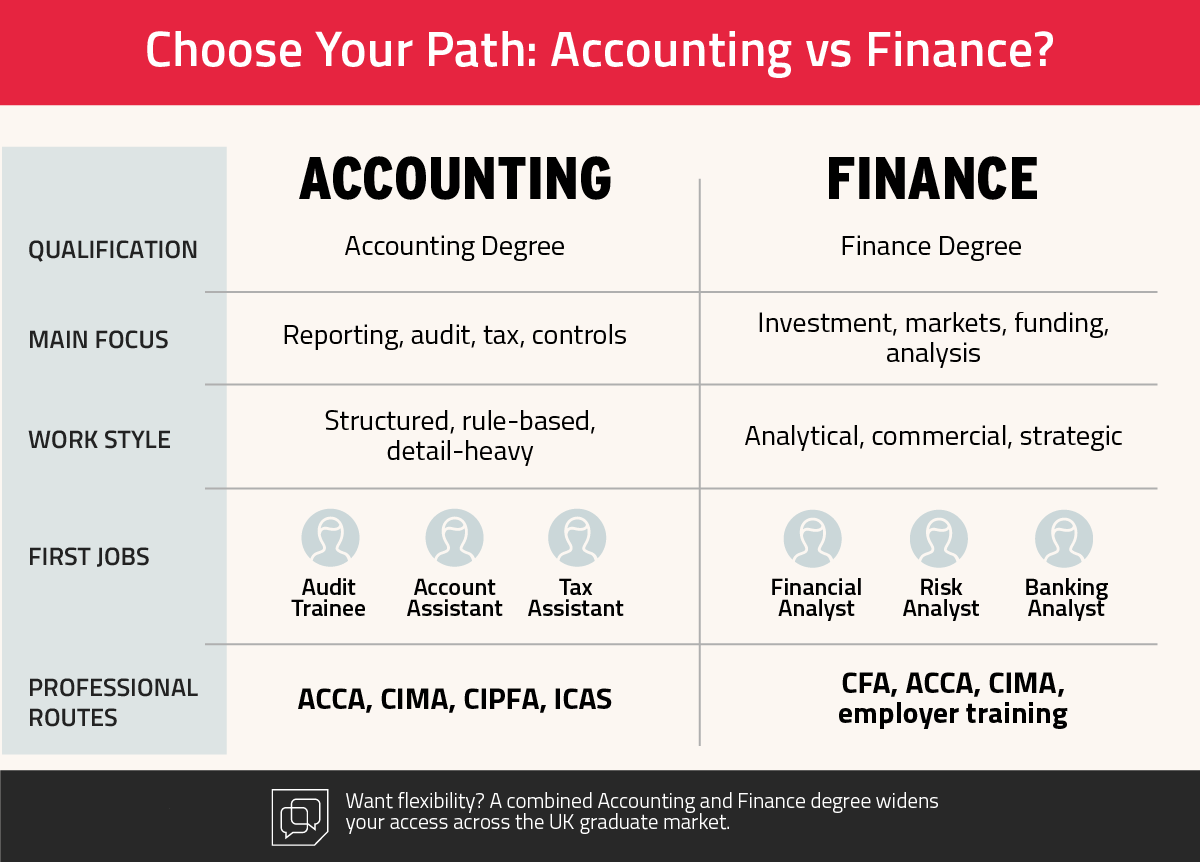
The choice between an accounting vs finance degree depends largely on the type of work and career path you prefer. An accounting career fits you better if you prefer structure, rule-based work involving compliance, reporting, audit, taxation, and financial accuracy. A finance career fits you better if you are interested in markets, investment, valuation, strategy, and commercial analysis.
The table below compares career paths with accounting degree and finance degree.
| Area |
Accounting degree |
Finance degree |
| Main focus |
Reporting, audit, tax, controls |
Investment, markets, funding, analysis |
| Typical work style |
Structured, rules-based, detail-heavy |
Analytical, commercial, strategic |
| Common first jobs |
Audit trainee, assistant accountant, tax assistant |
Financial analyst, risk analyst, banking analyst |
| Professional routes |
ACCA, CIMA, ICAEW, ICAS |
CFA, ACCA, CIMA, employer training |
| Sector spread |
Universal across all organisations |
Strong in banking, corporate and investment settings |
Main focus
Accounting degree
Reporting, audit, tax, controls
Finance degree
Investment, markets, funding, analysis
Typical work style
Accounting degree
Structured, rules-based, detail-heavy
Finance degree
Analytical, commercial, strategic
Common first jobs
Accounting degree
Audit trainee, assistant accountant, tax assistant
Finance degree
Financial analyst, risk analyst, banking analyst
Professional routes
Accounting degree
ACCA, CIMA, ICAEW, ICAS
Finance degree
CFA, ACCA, CIMA, employer training
Sector spread
Accounting degree
Universal across all organisations
Finance degree
Strong in banking, corporate and investment settings
A combined Accounting and Finance degree can be a suitable option if you want broader exposure to both subjects before choosing a more specialised career path. At Edinburgh Napier University, this route can support access to graduate opportunities across accounting, finance, banking, and professional services.
Can I Become an Accountant With a Finance Degree?
Yes, you can become an accountant with a finance degree. A finance degree qualifies graduates for the ACCA, CA, ACA, and CIMA professional accountancy routes but does not guarantee the same level of exemptions as a combined accounting and finance degree or an accredited accounting degree. The distinction depends on module content.
ACCA awards exemptions based on the specific accounting modules a graduate has studied, including financial reporting, management accounting, audit, and taxation. A finance degree that includes these modules as many combined accounting and finance degrees do can attract the same nine-paper exemption as an accredited accounting degree. A finance degree without these specific modules attracts fewer exemptions and may require completion of ACCA's Applied Knowledge level before progressing.
The clearest route to accountancy from university is an accredited accounting and finance degree that explicitly maps module coverage to ACCA, CIMA, ICAEW, and ICAS exemption requirements. Applicants should verify accreditation status and exemption schedules directly with the university before accepting an offer.
If you are deciding between university study and a professional qualification should also compare an accounting degree vs ACCA, because the two routes differ in academic breadth, professional exemptions, study structure, and progression towards chartered status.
Does a master’s in accounting and finance offer better job prospects?
A master’s in Accounting and Finance can improve job prospects by developing advanced technical knowledge, strengthening analytical skills, and supporting access to specialist or postgraduate-level roles.
It can be valuable for graduates who want to:
- Move into accounting or finance from another subject.
- Qualify for professional exam exemptions.
- Develop expertise in areas such as financial reporting, corporate finance, audit, or investment analysis.
- Apply for competitive graduate schemes or specialist roles.
- Build a stronger academic foundation before pursuing ACCA, CIMA, ICAEW, ICAS, or CIPFA.
However, a master’s degree does not guarantee better employment outcomes. Its value depends on professional accreditation, relevant work experience, employer demand, and how closely the course aligns with the career you want.
Why study accounting and finance degrees at Edinburgh Napier University?
The benefits of studying accounting and finance degrees at Edinburgh Napier University are listed below.
1- Accounting and finance courses are accredited by leading Professional bodies including ACCA, CIMA, ICAEW, ICAS, and CIPFA, this gives you maximum exemptions from professional accountancy qualification exam.
2- According to DiscoverUni data of Edinburgh Napier University:
- 65% of BA (hons) Accounting graduates are in work 15 months after graduation, 5% are in further study, 15% are working and studying.
- 60% of BA (hons) Accounting with Corporate Finance graduates are in work 15 months after graduation, 10% are in further study, 25% are working and studying.
3- You will study accounting and finance degree at
AACSB accredited Business School.
4- Edinburgh Napier’s industry links give students structured access to internships, employer networking events, and graduate recruitment opportunities across Edinburgh’s financial sector.
5- According to the Times World University Rankings 2025 and the Good University Guide 2025, Edinburgh Napier ranks as #1 Modern University in Scotland and #1 UK Modern University for Accounting and Finance.
Accounting and Finance courses at Edinburgh Napier University
Edinburgh Napier University offers following accounting and finance courses:
- BA (hons) Accounting
- BA (hons) Accounting with Corporate Finance
- BA (hons) Financial Services
- BA/BA (hons) Accounting and Finance
- MSc Accounting
- MSc International finance
What Career and Employability Support Is Available at ENU for Accounting and Finance Students?
Edinburgh Napier University provides five categories of career and employability support for accounting and finance students. It includes career guidance, employer engagement, placement support, professional body partnerships, and alumni mentoring.
- Career guidance at ENU is delivered through the Employability and Careers Service, which offers 1-to-1 appointment sessions, CV and application reviews, interview preparation, and graduate job search support. Students access the service from Year 1 and continue to access it for up to three years after graduation.
- Employer engagement takes the form of on-campus employer presentations, careers fairs, and networking events. Accounting and finance employers including accounting firms, financial services companies, and public sector employers present directly to students through the ENU Business School's employer partnership programme.
- Placement support enables students to complete a placement year between Year 3. Placements are arranged in collaboration with the Employability and Careers Service and give students 12 months of industry experience that strengthens both professional qualification applications and graduate employment prospects. It varies from course to course.
- Professional body partnerships mean that ENU's degree carries verified exemption schedules from ACCA, CIMA, ICAEW, CIPFA, and ICAS. Students receive guidance on registration, exemption claims, and qualification planning as part of the degree programme that reduces the administrative complexity of transitioning from degree to professional qualification.
- Alumni mentoring connects current students with ENU accounting and finance graduates working across professional services, financial services, and corporate finance. Mentoring relationships provide insight into employer expectations, application strategies, and career progression that complements formal careers guidance.