An accountant is a financial professional who records, analyses, and reports on the financial transactions of individuals, businesses, and organisations. In the UK, accountants work across four main specialisms: financial accounting, management accounting, tax accounting, and public sector accounting. The title “accountant” is not legally protected in the UK, but “chartered accountant” is legally protected and requires a recognised professional qualification through a body such as ICAEW, ICAS, ACCA, CIMA, or CIPFA.
To become a qualified accountant in the UK, you usually follow one of two routes: a degree route or a non-degree route. A degree alone does not make you a qualified accountant, but an accredited accounting degree - such as the BA (Hons) Accounting or BA (Hons) Accounting with Corporate Finance at Edinburgh Napier University can provide exemptions from up to nine ACCA professional exams and reduce the time needed to reach full qualification. Without a degree, the most common routes are the AAT qualification pathway and accounting apprenticeships at Levels 2 to 6.
Qualified accountants in the UK earn an average salary of around £47,000, with chartered accountants in senior roles earning between £60,000 and £90,000. Entry-level graduate salaries in Scotland typically range from £22,000 to £28,000 and rise after professional qualification. For many students with Highers or A-levels, the degree route can be the faster route because it combines academic study, professional exam exemptions, and access to graduate accounting opportunities.
In Scotland, ICAS is the world’s oldest professional accountancy body, founded in Edinburgh in 1854 and awards the CA designation. The CA qualification is a leading chartered accountancy credential in Scotland and is recognised internationally. Edinburgh Napier University is an ICAS-accredited institution, meaning accounting graduates can enter professional training with academic exemptions already in place. The seven core skills required to become an accountant are numerical analysis, financial reporting, attention to detail, communication, commercial awareness, digital literacy, and ethical judgement.
What is an Accountant?
An accountant is a qualified finance professional who records, classifies, and interprets the financial transactions of an individual, business, or public organisation. In the UK, accountants practice across 4 main specialisms, each defined by the type of organisation served and the financial function performed.
- Financial accountants prepare statutory reports for external stakeholders, including annual accounts, income statements, and balance sheets.
- Management accountants produce internal reports guiding business decisions including budget variance analysis, rolling forecasts, and scenario models for strategic planning.
- Tax accountants administer HMRC compliance and tax planning across 3 core tax types: corporation tax, VAT, and payroll tax.
- Public sector accountants manage the finances of government bodies, NHS trusts, and public services under IPSAS and the Financial Reporting Manual (FReM).
Accountant vs Chartered Accountant
A chartered accountant holds a legally protected professional title, regulated under UK law. The title is awarded by 5 UK chartered accountancy bodies: ICAEW (Institute of Chartered Accountants in England and Wales), ICAS (Institute of Chartered Accountants of Scotland), ACCA (Association of Chartered Certified Accountants), CIMA (Chartered Institute of Management Accountants), and CIPFA (Chartered Institute of Public Finance and Accountancy). The title "accountant" carries no legal protection in the UK as any person without holding a recognised professional qualification can use it. The title "chartered accountant" is legally protected and requires completing a formal training programme with an authorised employer and professional body examinations.
What Does an Accountant Do?
Accountants record, analyse, and communicate financial information to support 3 main organisational functions: decision-making, ensure legal compliance, and manage financial risk. The day-to-day responsibilities of an accountant vary by specialism, employer size, and career stage. The following 6 core tasks apply across all accounting roles, from graduate trainee to qualified accountant.
- Financial statement preparation is the most fundamental task performed by accountants in every specialism. Accountants produce balance sheets, income statements, and cash flow statements in accordance with IFRS for listed companies or UK GAAP standards for private entities.
- Tax compliance management involves calculating, reporting, and submitting corporation tax, VAT, and payroll tax returns to HMRC. Tax accountants also advise businesses on legal tax planning strategies to minimise liability within HMRC guidelines.
- Management accounts production delivers monthly or quarterly financial performance reports to business leaders. Management accountants track budgets, analyse variances between forecast and actual figures, and model financial scenarios to inform strategic decisions.
- Audit involves independently examining a company's financial records to verify accuracy and compliance. Audit is a separate specialism within accounting like auditors work for external firms such as Deloitte, PwC, EY, and KPMG, or in-house internal audit functions within large organisations.
- Payroll and accounts payable management covers processing employee salaries, administering pension contributions, and reconciling supplier invoices. These tasks are common in practice-based roles and smaller finance teams, particularly at entry and intermediate career levels.
- Financial advisory services represent the senior-level dimension of the accountant role. Qualified accountants advise on mergers and acquisitions, business valuations, corporate restructuring, and investment decisions. This advisory dimension is most prominent in roles at Big 4 firms and in-house CFO or finance director positions.
Why Become an Accountant in the UK?
A career in accountancy in the UK offers high job security with increasing demand, high earning potential, stable career growth, and global mobility. According to the 2026 Salary Guide published by Robert Half, freshly qualified accountants in the UK earn an average salary of £47,000 per year. According to the 2026 Salary Guide by Michael Page, qualified accountants in the UK including Scotland earn between £45,000 and £60,000.
3 structural factors make accounting a strong long-term career choice in the UK:
- Consistent demand across all employers: every business, public body, and charity requires accounting expertise, making the profession resilient to economic downturns.
- International portability: ACCA, CIMA, and ICAS qualifications are recognised in over 180 countries, giving qualified accountants global mobility.
- Structured progression: accounting careers follow a clear hierarchy from graduate trainee to qualified accountant, manager, finance director, and CFO, with each stage tied to specific qualification milestones.
Students considering accountancy can also compare wider accounting and finance careers, because degree-level accounting and finance skills can lead into audit, tax, corporate finance, management accounting, financial analysis, and advisory roles.
What Qualifications Are Required to Become an Accountant in the UK?
The main qualifications required to become a qualified accountant in the UK are professional accountancy qualifications such as ACCA, CIMA, ICAEW, ICAS, or CIPFA. You can work towards these qualifications through an accredited accounting degree, a non-degree route, an apprenticeship, or after completing a degree in another subject.
An accredited accounting degree can provide exemptions from selected professional exams and give access to graduate schemes. Non-degree and apprenticeship routes allow students to begin professional training while working, while graduates from other subjects can enter accountancy through professional exams with fewer or no exemptions.
The table below compares the main qualification routes to become an accountant in the UK.
| Routes |
Best for |
Entry point |
Typical qualification path |
Main advantage |
Main limitation |
| Accounting degree route |
Students wanting graduate roles and exemptions |
Highers, A-levels, or equivalent |
Degree, then ACCA/ICAS/ICAEW/CIMA/CIPFA |
Exemptions, graduate schemes, wider career options |
Tuition cost and longer full-time study |
| Non-degree route |
School leavers or career changers wanting to earn early |
GCSEs/National 5s/Highers depending on employer |
AAT, then ACCA/CIMA/other body |
Earn while learning, less university debt |
More exams and potentially slower progression |
| Apprenticeship route |
Students wanting work-based study |
Employer-dependent |
Apprenticeship plus professional qualification |
Salary plus funded study |
Competitive and employer-dependent |
| Non-accounting degree route |
Graduates from another subject |
Existing degree |
Transcript assessment, then professional exams |
Career change possible without restarting |
Fewer exemptions than accounting graduates |
Accounting degree route
- Best for: Students wanting graduate roles and exemptions
- Entry point: Highers, A-levels, or equivalent
- Typical qualification path: Degree, then ACCA/ICAS/ICAEW/CIMA/CIPFA
- Main advantage: Exemptions, graduate schemes, wider career options
- Main limitation: Tuition cost and longer full-time study
Non-degree route
- Best for: School leavers or career changers wanting to earn early
- Entry point: GCSEs/National 5s/Highers depending on employer
- Typical qualification path: AAT, then ACCA/CIMA/other body
- Main advantage: Earn while learning, less university debt
- Main limitation: More exams and potentially slower progression
Apprenticeship route
- Best for: Students wanting work-based study
- Entry point: Employer-dependent
- Typical qualification path: Apprenticeship plus professional qualification
- Main advantage: Salary plus funded study
- Main limitation: Competitive and employer-dependent
Non-accounting degree route
- Best for: Graduates from another subject
- Entry point: Existing degree
- Typical qualification path: Transcript assessment, then professional exams
- Main advantage: Career change possible without restarting
- Main limitation: Fewer exemptions than accounting graduates
How to Become an Accountant With a Degree?
To become an accountant with a degree, you complete a 4-year undergraduate accounting, finance or combined accounting and finance programme and then enter a professional training contract with ACCA, CIMA, ICAEW, ICAS, or CIPFA. The degree builds technical expertise in financial reporting, management accounting, taxation, and audit. These same subjects are covered in early-stage professional exams, so accredited programmes can provide professional exam exemptions that shorten qualification timeline.
Which Degree Do You Need to Become an Accountant?
An accounting degree is the most direct route to professional accountancy qualification in the UK. Accounting degrees accredited by ACCA, ICAEW, CIMA, ICAEW, and ICAS align their curriculum directly to professional body syllabuses, earning graduates the maximum number of exam exemptions.
Edinburgh Napier University offers two highly accredited accounting degree programmes designed for students targeting a professional accounting career.
- BA (Hons) Accounting covers financial accounting, management accounting, taxation, and audit modules mapped directly to ACCA, CIMA, ICAEW, CIPFA, and ICAS professional syllabuses. This is the core route for students targeting all major professional body qualifications.
- BA (Hons) Accounting with Corporate Finance covers the same core accounting disciplines plus 3 specialist modules including corporate finance, investment analysis, and financial management. This degree suits students targeting roles in financial services, corporate treasury, or investment banking, while still earning maximum professional accountancy exam exemptions.
Both degrees are taught in Edinburgh, positioning graduates directly in Scotland's financial services hub with access to ICAS training contract employers, Big 4 offices, and a strong mid-tier accounting practice sector.
How to Become an Accountant With a Non-Accounting Degree?
To become an accountant with a non-accounting degree, submit your degree transcript to ACCA, CIMA, or ICAEW during registration. Each body assesses your specific completed modules against its professional syllabus and awards exemptions based on subject overlap. The number of exemptions received and the remaining exams required varies by degree discipline and body.
For example, according to ACCA's published exemptions framework, the remaining exam requirement by degree type breaks down across 3 graduate profiles.
- Accounting degree graduates receive up to 9 ACCA exemptions, leaving 4 Strategic Professional papers.
- Business management, economics, or mathematics degree graduates receive up to 4 ACCA exemptions, leaving between 9 and 10 papers depending on specific modules completed.
- Graduates from wholly unrelated fields such as English literature, history, or engineering receive no ACCA exemptions and sit all 13 papers.
The total qualification timeline for a non-accounting graduate is approximately 1 to 2 years longer than for an accounting graduate, depending on the professional body and the number of remaining exams. ACCA, CIMA, and ICAEW each provide an online exemption calculator that accepts individual module inputs and returns the exact number of exemptions awarded before registration.
A non-accounting degree does not prevent entry into professional accounting qualifications. Graduates with degrees in business management, economics, mathematics, or law enter ACCA, CIMA, or ICAEW with partial exemptions (if applicable), based on the modules completed during their degree.
How Long Does It Take to Become an Accountant With a Degree?
Becoming a fully qualified accountant via the degree route takes between 6 and 7 years in total. This breaks down as 4 years for the undergraduate degree, plus 2 to 3 years for remaining professional exams and a training contract.
Accounting degree graduates complete this faster than non-accounting graduates. An accounting graduate entering ACCA sits 4 remaining exams being achievable in approximately 18 to 24 months alongside a training contract. A non-accounting graduate sits 8 to 13 remaining exams, adding 1 to 2 additional years.
The ICAS CA qualification requires a minimum 3-year training contract. Graduates of an ICAS-accredited institution such as Edinburgh Napier University begin that contract with academic exemptions already recognised, meaning the formal exam burden during the training period is reduced from the start.
What Are the Benefits of Becoming an Accountant With a Degree?
The Benefits of Becoming an Accountant With a Degree are listed below. The degree route delivers 6 specific advantages over the non-degree route. These advantages overlap with the wider benefits of studying accounting and finance, including career flexibility, professional progression, and stronger access to graduate opportunities.
- Exam exemptions: Degree route reduces the total professional exams required. Accounting graduates entering ACCA sit 4 exams instead of 13, saving approximately 2 years of additional study compared to a non-graduate ACCA candidate.
- Graduate training contract access: Degree route offers broader access to training contracts. Big 4 firms (Deloitte, PwC, EY, and KPMG) require a degree as a minimum entry condition. These firms offer training salaries between £25,000 and £32,000 in Scotland, rising to between £45,000 and £55,000 on qualification. According to the 2026 Salary Guide by Reed, Accountants in Edinburgh earn competitive salaries to those in London.
- Academic grounding in professional standards: Awareness of professional standards prepares graduates for the conceptual rigour of professional exams. Students who study IFRS and UK GAAP at degree level perform better in professional papers covering financial reporting than those encountering these standards for the first time.
- Career flexibility: Degree route provides greater career flexibility at graduate level. An accounting degree opens routes into audit, corporate finance, tax, investment management, and financial consulting. It is not limited to compliance and bookkeeping roles.
- Relevance of higher education: According to 2025 Professional Services Sectoral Skills Assessment by Skills Development Scotland (SDS), 77%of workers in the professional services sector were qualified to SCQF level 7 and above. It confirms that post-school qualifications are the norm in the occupational ecosystem where many accounting jobs exist. A degree positions graduates within the dominant qualification tier of their target labour market from day one.
- Skill Development: An accounting degree develop skills like financial reporting, attention to details, communication, commercial awareness, digital literacy, and numerical analysis. These skills are highly important in the accountancy career.
How to Become an Accountant Without a Degree?
To become an accountant without a degree requires completing professional qualifications through on-the-job study, apprenticeships, or self-funded study programmes. The most common starting point is the AAT (Association of Accounting Technicians) qualification.
Completing AAT Level 4 provides entry into ACCA and CIMA professional qualifications, continuing the route toward chartered status. The non-degree route reaches the same professional qualifications as the degree route through 3 pathways: AAT-to-ACCA study, AAT-to-CIMA study, and accounting apprenticeships at Levels 2 to 6.
What Are the Benefits and Limitations of the Non-Degree Route?
The non-degree route has 2 main advantages. First, it allows school leavers to enter the profession and earn a salary from age 16 to 18, without accumulating student debt. According to the 2023 AAT Salary Survey, students aged 16 to 18 earn an average salary of £14,400. Second, practical accounting experience is built from the start. Candidates work in accounting environments like SME finance teams, accountancy practices from their first year.
The limitations of non-degree routes are listed below.
- The non-degree route requires sitting more professional exams up to 13 ACCA exams compared to 4 for an accounting graduate.
- Total study time from AAT Level 2 to ACCA qualified status typically spans 6 to 8 years, up to 2 years longer than the degree route.
- Access to Big 4 training contracts is highly competitive, as most require a degree as a minimum entry condition.
- Starting salaries in non-graduate accounting roles begin between £18,000 and £22,000 which is lower than graduate starting salaries.
- Change in industry shift to automation and more digital focus is causing decline in jobs for bookkeepers, payroll assistants etc.
- According to the 2025 Professional Services Sectoral Skills Assessment by Skills Development Scotland, digital practitioner roles include occupations like Chartered and Certified Accountants, and Finance and Investment Analysts and Advisers are in high demand. These roles cannot be achieved easily with non-degree routes.
How to Become an Accountant Through an Apprenticeship?
To become an accountant through an apprenticeship you need a work-based qualification route that combines salaried employment with structured study. Apprentices earn a salary while working toward a recognised professional qualification. There are 2 main accounting apprenticeship types in the UK.
To become an accountant through an apprenticeship, identify the appropriate apprenticeship level, secure a sponsoring employer, and apply directly through the employer's recruitment process or through UCAS for Level 6 programmes.
The 2 accounting apprenticeship standards available in the UK are listed below.
1- The AAT Accounting Apprenticeship (Levels 2 to 4) is the most accessible entry point for school leavers. It suits candidates aged 16 and above with no prior accounting qualifications. The programme spans approximately 12 to 18 months per level. Completion of AAT Level 4 provides entry into ACCA or CIMA professional qualifications, continuing the journey toward chartered status.
2- The Accounting and Finance Degree Apprenticeship (Level 6) combines a full accounting degree with a professional training contract over 4to 5 years of salaried employment. This route delivers a degree and professional exam credits without university tuition fees. Level 6 places are available through a limited employer base: the Big 4 firms (Deloitte, PwC, EY, and KPMG), large public sector organisations including HMRC, and selected large corporations and entry is competitive.
How Long Does It Take to Become an Accountant Without a Degree?
Becoming a fully qualified accountant without a degree takes between 6 to 8 years. The AAT-to-ACCA route breaks down as approximately 3 years for AAT Levels 2 to 4, plus 3 to 4 years for ACCA exams and practical experience requirements. The degree apprenticeship route takes 4 to 5 years and delivers a degree alongside professional exam credits, effectively bridging the gap between the two routes.
How to Choose the Right Path to Becoming an Accountant?
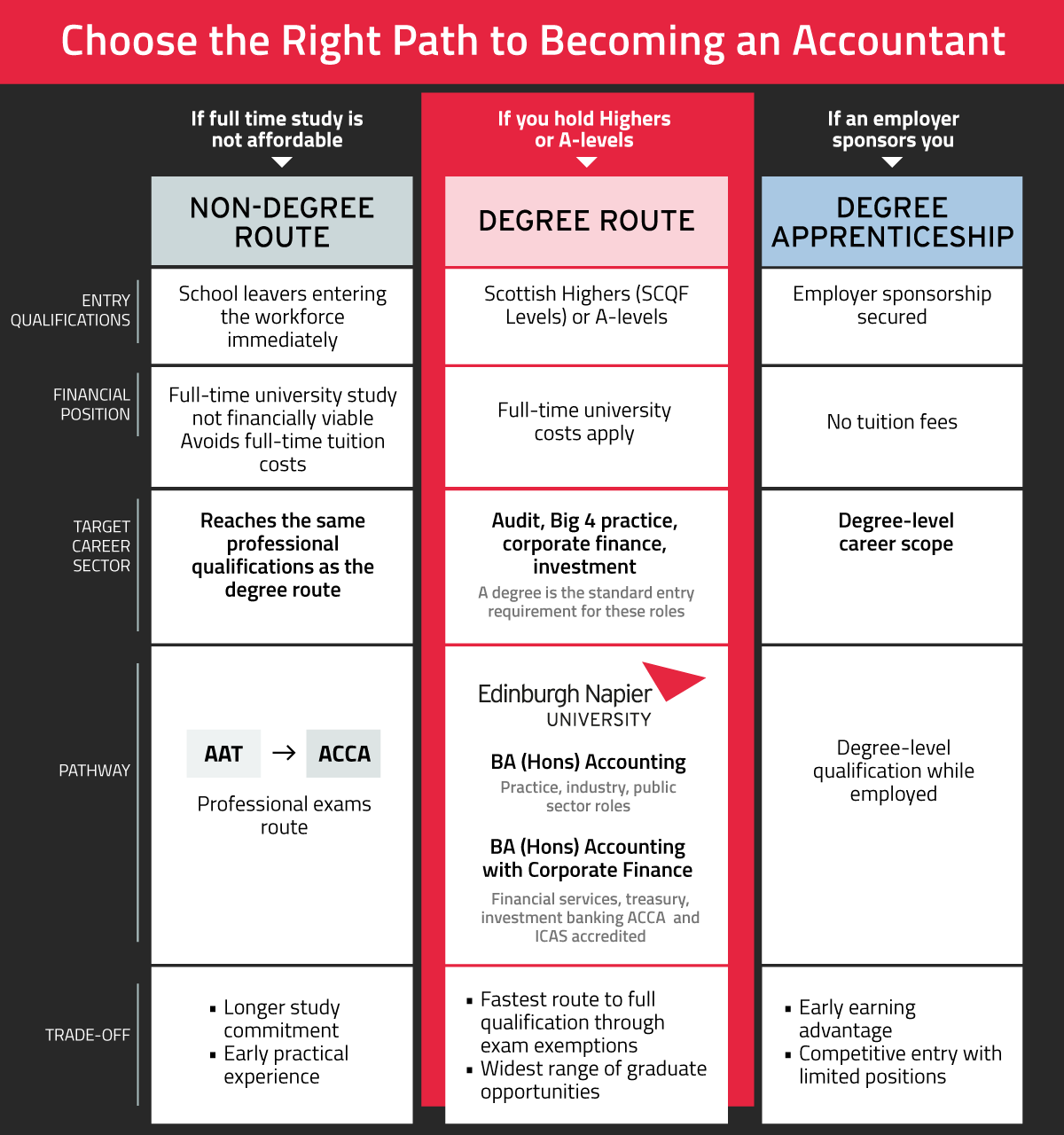
To choose the right path to becoming an accountant, assess 3 decision factors: your current entry qualifications, your financial circumstances, and your target career sector. Each factor maps to a different route profile below.
1- Choose the degree route If you hold Scottish Highers (SCQF Level 6) or A-levels and are targeting roles in audit, Big 4 practice, corporate finance, or investment. These roles require a degree as a standard entry requirement. An accounting degree delivers the fastest route to full professional qualification through exam exemptions and opens the widest range of graduate opportunities. The BA (hons) Accounting, BA (hons) Accounting with Corporate Finance degrees at Edinburgh Napier University are an ACCA and ICAS accredited programme that maximises exemptions at graduation.
The Accounting BA suits students targeting all major professional body qualifications across practice, industry, and the public sector. The Accounting with Corporate Finance BA suits students targeting financial services, corporate treasury, or investment banking roles while retaining the same exemption profile.
2- Choose the non-degree route if you are a school leaver entering the workforce immediately, or if full-time university study is not a financially viable option. The AAT-to-ACCA pathway leads to the same professional qualifications as the degree route. It requires a longer total study commitment but provides early practical experience.
3- Choose a degree apprenticeship if you can secure employer sponsorship and want a degree-level qualification without tuition fees. This route is competitive and positions are limited, but it combines the early earning advantage of the non-degree route with the career scope of the degree route.
Further, a detailed comparison of the accounting degree vs ACCA professional qualification can help students evaluate differences in cost, study time, exam exemptions, and career outcomes before choosing a route.
What Skills Do You Need to Become an Accountant?
The seven core skills required to become an accountant in the UK are: numerical analysis, financial reporting, attention to detail, communication, commercial awareness, digital literacy, and ethical judgement. These skills are assessed within the professional qualification pathways of ACCA, CIMA, ICAEW, CIPFA, and ICAS.
- Numerical analysis: It is the ability to interpret financial data, identify trends, and draw accurate conclusions from figures. Accountants apply numerical analysis across all areas of their work, from preparing management accounts to evaluating investment decisions.
- Financial reporting: It is the technical skill of preparing and interpreting financial statements in accordance with recognised standards, including IFRS, UK GAAP, and IPSAS. Financial reporting competency is a mandatory requirement of all major UK professional accounting qualifications.
- Attention to detail: It ensures the accuracy of financial records. A single error in a statutory account can carry legal and financial consequences for a business and its directors.
- Communication: It covers both written and verbal skills. Accountants present complex financial information to non-financial audiences, including directors, investors, and auditors. Clear communication is a graded competency within both the ACA and CA professional assessments.
- Commercial awareness: It is the ability to connect financial data to business context and strategic decisions. The Institute of Student Employers consistently identifies commercial awareness as the skill most lacking among new accounting graduates entering the profession.
- Digital literacy: It includes proficiency in accounting software such as Xero, Sage, and QuickBooks, alongside Excel and data analysis tools. Large practices and finance departments also require familiarity with ERP (Enterprise Resource Planning) systems such as SAP and Oracle. Using AI to automate regular accounting tasks is becoming an important skill in Scotland’s Financial and Business Services sector.
- Ethical judgement: It is the competency that governs every decision an accountant makes in practice. Accountants are legally required to act in the public interest under the ethical codes of their professional bodies. ACCA, CIMA, ICAEW, and ICAS all require candidates to pass a professional ethics module as part of their qualification pathway.
How to Become an Accountant in Scotland?
To become an accountant in Scotland, the primary chartered route is the ICAS CA qualification. It is available exclusively through ICAS, world's oldest professional accountancy body, founded in Edinburgh in 1854. ICAS awards the CA (Chartered Accountant) designation, which is recognised internationally and carries particular prestige within Scotland's financial services sector, concentrated in Edinburgh and Glasgow.
To become a CA through ICAS in Scotland, you complete the ICAS professional exam programme and a 3-year training contract with an ICAS-authorised employer. Authorised employers offering ICAS training contracts in Scotland include the Big 4 firms, mid-tier practices such as Johnston Carmichael, Chiene + Tait, and Scott-Moncrieff, and public sector organisations including Audit Scotland and the Scottish Government.
Edinburgh Napier University is an ICAS-accredited institution. Graduates of the Accounting BA (Hons) and Accounting with Corporate Finance BA (Hons) programmes enter ICAS with academic exemptions already in place, reducing the formal exam load before the training contract begins.
Scotland also has strong demand for ACCA-qualified accountants, particularly within SMEs, financial services, and the public sector. CIPFA qualification is directly relevant for accountants targeting roles in Scottish local government, NHS Scotland, and Scottish Government finance departments.
Is It Hard to Become an Accountant?
Yes, becoming a qualified accountant is academically demanding at the professional qualification stage, but the majority of candidates who follow employer-supported structured study programmes qualify successfully. The professional exams at the final stage including ACCA Strategic Professional, ACA Advanced, and ICAS CA Final are rigorous by design. ICAEW reports that first-time pass rates for ACA exams average between 70% and 85% depending on the paper. ACCA Strategic Professional exams carry pass rates between 30% and 50%, reflecting the difficulty of the qualification's final stage.
The total volume of study is the most common challenge. ACCA estimates that each of its 13 exams requires between 80 and 120 hours of study. Completing all 13 exams requires approximately 1,040 to 1,560 total study hours, spread over several years alongside full-time employment. Accounting degree graduates who enter ACCA with 9 exemptions reduce that total by approximately 720 to 1,080 hours, a substantial difference in overall workload.
Structure makes the process manageable. Candidates who complete the qualification through employer-supported training programmes, where study leave and exam fees are funded by the employer, achieve higher pass rates and qualify faster than self-funded candidates.
Can You Become an Accountant With a Business Management Degree?
Yes, you can become an accountant with a business management degree. A business management degree provides a recognised route into professional accounting qualifications in the UK. ACCA can award up to 5 exemptions to business management graduates, based on the specific modules completed. This means a business management graduate can enter ACCA with 8 remaining exams rather than the full 13 more than an accounting graduate, but a shorter path than a candidate with no relevant degree.
CIMA recognises business management degrees for entry into the CIMA qualification pathway, with exemptions at Certificate level. Management accounting aligns closely with business management curricula covering budgeting, performance measurement, and strategic financial analysis making CIMA a natural professional progression for business management graduates.
The practical step is to submit your degree transcript to ACCA or CIMA during the registration process. Both bodies provide online exemption calculators that map specific degree modules to their exam syllabuses. The number of exemptions awarded depends on which modules were completed and the grades achieved.
Students deciding between the two subjects may also compare accounting and finance vs business management, because the degrees differ in professional exemptions, technical depth, and the range of accounting career pathways they support.
Do you need an accounting degree to become an accountant?
No, you do need an accounting degree to become an accountant. Professionally, employers and clients strongly prefer or effectively require professional-body affiliation and demonstrable competence, which degrees and/or structured professional pathways support.
Do you need a degree to start a chartered route?
No, you do not always need a degree to start a chartered route. ICAS explicitly states you do not need a degree to study with ICAS, and ICAEW explicitly states you do not need a degree to register as an ACA student. You need qualifications meeting university admission standards.
If you can start without a degree, why recommend a degree anyway?
Because the labour market you are aiming for is qualification-heavy and increasingly shaped by technology and higher-value advisory expectations. In Scotland’s Professional Services sector (which includes accounting activities), SDS estimates 77% of workers are qualified to SCQF Level 7+; degrees also enable structured exemptions/credits (ICAEW, ICAS, ACCA, CIMA) that can shorten exam load when used correctly.
Can you become an accountant with a different degree?
Yes, you can become an accountant with a different degree than accounting. ICAS’s graduate route states it is open to students from a variety of degree disciplines and that “it doesn’t matter what degree you have.” The practical consequence is that students with non-accounting degrees may have fewer exemptions and may need to invest more in the early technical stage to learn concepts and develop skills required but they are not blocked from entry.
An accountant is a qualified finance professional who records, classifies, and interprets the financial transactions of an individual, business, or public organisation. A chartered accountant holds a legally protected professional title, regulated under UK law. Big 4 firms (Deloitte, PwC, EY, and KPMG) require a degree as a minimum entry condition. Accountants in Edinburgh earn competitive salaries to those in London. Becoming a fully qualified accountant without a degree takes between 6 to 8 years.
This article has been reviewed by