
A professional exam exemption is an official recognition of prior learning that allows a candidate to bypass specified exams from a professional accountancy body. Exemptions reduce the number of exams required after university, but they do not grant qualified status on their own. Graduates still need to complete any remaining exams and meet practical experience requirements, usually through a training contract or approved employment route, before reaching chartered membership.
Exemptions are awarded through two main routes. Accredited degree mapping applies when a university programme is formally aligned with a professional body’s syllabus and students pass the required modules. Transcript assessment applies when an unaccredited degree is reviewed individually against the professional body’s syllabus. Edinburgh Napier University’s BA (Hons) Accounting and BA (Hons) Accounting with Corporate Finance provide exemption routes across all five main UK accountancy bodies including ACCA, ICAS, ICAEW, CIMA, and CIPFA.
The value of exemptions is practical and measurable. A full ACCA qualification includes 13 exams, but a fully accredited accounting degree can reduce this to four Strategic Professional papers, potentially saving up to three years of exam sittings and £3,000 to £6,000 in combined exam fees, study materials, and revision costs. For graduates of accredited programmes, the exemption route is usually faster and more cost-effective than direct entry, which requires sitting all professional exams from the starting level.
The fastest route to chartered status combines an accredited degree, maximum recognised exemptions, a training contract secured at or before graduation, and a professional body matched to the intended career sector. ICAEW or ICAS often suit public practice and audit, CIMA suits industry and management accounting, CIPFA suits public sector finance, and ACCA suits international accounting careers. Students should also check employer requirements and exemption validity periods, because some employers may still require specific papers and exemption windows vary by professional body.
What is an Accountancy Exam Exemption?
An accountancy exam exemption is an official recognition of prior learning by a professional accountancy body that allows you to bypass a certain number of its qualification exams. Exemptions are granted by assessing university level learning in relevant subjects like accounting, finance or other subjects and mapping it with professional body‘s own syllabus. Graduates do not qualify for professional qualifications automatically as they must complete the remainder of exams and required trainings to earn the qualification.
Each professional body sets its own exemption criteria, pass mark thresholds, applicable qualification levels, and awards exemptions based on accreditation agreements it hold with specific universities and their degree programmes.
The 5 main bodies granting exemptions in the UK for accounting and finance degrees are listed below.
- ACCA: exemptions apply across Foundations, Applied Knowledge, and Applied Skills levels; Strategic Professional is not exemptible.
- ICAEW: Credit for Prior Learning (CPL) applies at Certificate and Professional levels only; Advanced Level is not exemptible.
- ICAS: subject exemptions are linked to specific module completions, with a 3-year eligibility window.
- CIMA: exemptions map to apprenticeship certification and operational levels based on degree tier.
- CIPFA: PAQ module exemptions are available across all degree tiers within a 10-year window.
How Does a University Degree Lead to Professional Exam Exemptions?
A university degree leads to professional exemptions through two routes, one is accredited degree mapping and other is transcript assessment.
Accredited degree mapping applies when the programme is formally aligned to a professional syllabus. If you pass the right modules with minimum marks, you can claim exemptions. An accredited accounting and finance degree leads to most exemptions.
Transcript assessment applies when the programme is unaccredited, allowing the professional body to review module coverage individually with their syllabus.
Which accounting and finance degrees offer most exemptions?
Accounting-focused degrees, especially Accounting and Finance, Accountancy, and Professional Accounting programmes, usually offer the most exemptions from bodies such as ACCA, CIMA, ICAEW, ICAS, and CIPFA. The highest exemption levels are typically available on accredited courses with modules closely aligned to professional accountancy syllabuses.
Accounting and Finance degrees that attract highest exemption counts share the following four characteristics.
- Carry an accounting-heavy curriculum covering financial accounting, management accounting, taxation, audit, law, and financial reporting.
- Hold formal accreditation agreements with multiple professional bodies tied to specific module codes and explicit syllabus alignment.
- Include a meaningful exam assessment component within the degree structure.
- Maintain stable, codified module structures with consistent module codes across academic years.
Exemption apply to specific programmes rather than degree titles alone. Students should confirm their entitlement through the relevant professional body's exemption calculator or university's accreditations documentation.
What ACCA exemptions does an accounting and finance degree provide?
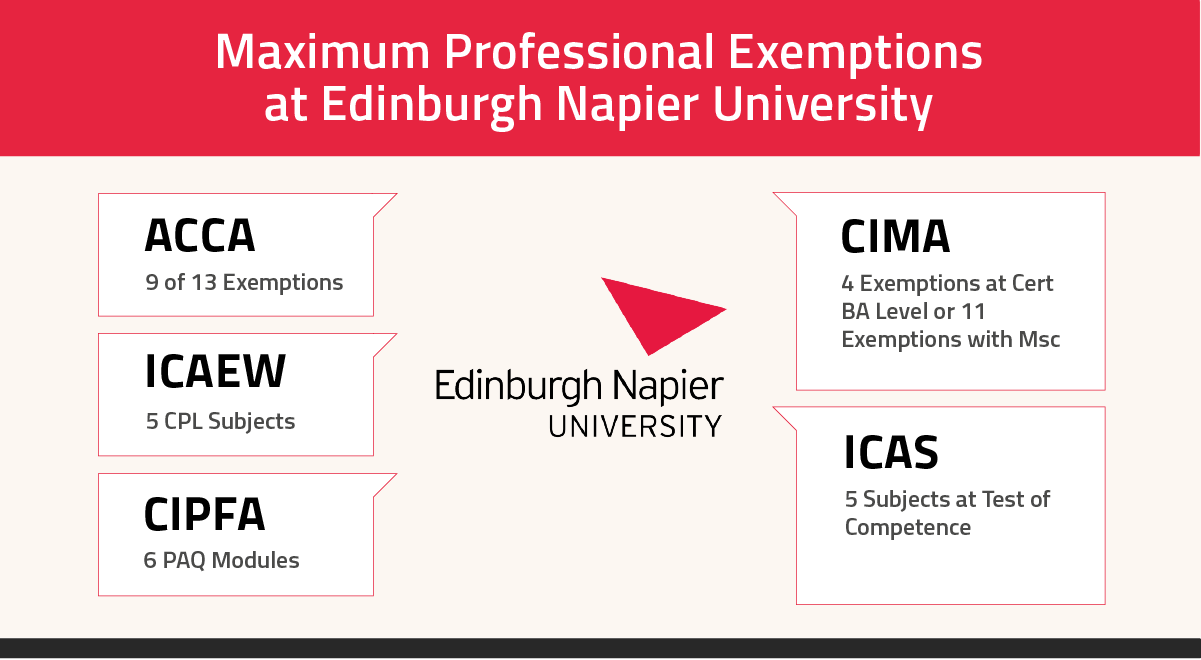
A fully accredited Accounting and Finance degree can provide up to nine ACCA exam exemptions across the Applied Knowledge and Applied Skills levels. Graduates awarded all nine exemptions can begin the ACCA exam pathway at the Strategic Professional level, where four exams remain.
Edinburgh Napier University students can claim 9 ACCA exam exemptions upon completing one of the following degrees.
- BA (hons) Accounting
- BA (hons) Accounting with Corporate Finance
Following four ACCA exemptions are awarded automatically on full degree completion.
- Business and Technology (BT)
- Management Accounting (MA)
- Financial Accounting (FA)
- Corporate and Business Law (LW)
Remaining five exemptions are conditional on completing specific modules. The table below lists each conditional ACCA exemption and its required Edinburgh Napier module.
| ACCA Exam |
Required Accounting/Finance Modules |
| Audit and Assurance (AA) |
Auditing |
| Financial Management (FM) |
Financial Management, Corporate Financial Management |
| Financial Reporting (FR) |
Corporate Accounting, Advanced Corporate Accounting |
| Performance Management (PM) |
Advanced Management Accounting |
| Taxation (TX) |
Taxation |
Audit and Assurance (AA)
- Required Accounting/Finance Modules: Auditing
Financial Management (FM)
- Required Accounting/Finance Modules: Financial Management, Corporate Financial Management
Financial Reporting (FR)
- Required Accounting/Finance Modules: Corporate Accounting, Advanced Corporate Accounting
Performance Management (PM)
- Required Accounting/Finance Modules: Advanced Management Accounting
Taxation (TX)
- Required Accounting/Finance Modules: Taxation
What CIMA exemptions does an Accounting and Finance degree provide?
A fully accredited Accounting and Finance degree can provide up to 11 CIMA exam exemptions. The number of exemptions depends on the degree title, qualification level, modules completed, and year of graduation.
Edinburgh Napier University students can claim CIMA exemptions with the following accounting and finance degrees.
- Graduates of BA (hons) Accounting with Corporate Finance, and BA (hons) Financial Services can claim 4 CIMA exemptions at Cert BA level 1.
- Graduates of MSc Accounting can claim up to 11 CIMA exemptions across 3 levels, including the Operational Case Study Exam.
The table below lists each CIMA exemption, its qualification level, and Edinburgh Napier accounting degrees required to claim it.
| CIMA Level |
CIMA Paper |
Qualifying Degree |
| Cert BA, Level 1 |
BA1, BA2, BA3, BA4 |
BA (Hons) Accounting with Corporate Finance and BA (hons) Financial Services |
| Cert BA, Level 1 |
BA1, BA2, BA3, BA4 |
MSc Accounting |
| Operational OT, Level 2 |
E1, F1, P1 |
MSc Accounting |
| Operational CS, Level 2 |
Operational Case Study Exam |
MSc Accounting |
| Management OT, Level 3 |
E2, F2, P2 |
MSc Accounting |
Cert BA, Level 1
- CIMA Paper: BA1, BA2, BA3, BA4
- Qualifying Degree: BA (Hons) Accounting with Corporate Finance and BA (hons) Financial Services
Cert BA, Level 1
- CIMA Paper: BA1, BA2, BA3, BA4
- Qualifying Degree: MSc Accounting
Operational OT, Level 2
- CIMA Paper: E1, F1, P1
- Qualifying Degree: MSc Accounting
Operational CS, Level 2
- CIMA Paper: Operational Case Study Exam
- Qualifying Degree: MSc Accounting
Management OT, Level 3
- CIMA Paper: E2, F2, P2
- Qualifying Degree: MSc Accounting
What ICAEW exemptions does an accounting and finance degree provide?
Edinburgh Napier University's BA (Hons) Accounting and BA (Hons) Accounting with Corporate Finance can provide credit for prior learning (CPL) in five ICAEW subjects. Each credit requires a minimum mark of 50% in the corresponding university module.
The table below lists each ICAEW CPL subject, the required pass mark, and the corresponding degree module.
| ICAEW Subject |
Pass Mark |
Required Module |
| Accounting Fundamentals |
50% |
Financial Accounting (ACC07102) |
| Assurance Risk Fundamentals |
50% |
Auditing (ACC09109) |
| Business Insight and Performance |
50% |
Management Accounting (ACC07101); Financial Management (ACC08105) |
| Business Law |
50% |
Business and Corporate Law (LAW08102) |
| Tax Fundamentals |
50% |
Taxation (ACC09103) |
Accounting Fundamentals
- Pass Mark: 50%
- Required Module: Financial Accounting (ACC07102)
Assurance Risk Fundamentals
- Pass Mark: 50%
- Required Module: Auditing (ACC09109)
Business Insight and Performance
- Pass Mark: 50%
- Required Module: Management Accounting (ACC07101); Financial Management (ACC08105)
Business Law
- Pass Mark: 50%
- Required Module: Business and Corporate Law (LAW08102)
Tax Fundamentals
- Pass Mark: 50%
- Required Module: Taxation (ACC09103)
What ICAS exemptions does an accounting and finance degree provide?
Edinburgh Napier University’s BA (Hons) Accounting and BA (Hons) Accounting with Corporate Finance can provide you up to five exemptions at the Knowledge level of the ICAS CA qualification. You cannot get exemptions foo the Skills or Integration levels.
Graduates can be eligible for these exemptions if they apply within three years of completing the degree.
The table below lists each ICAS subject, and the required degree module to qualify for exemption.
| ICAS Subject |
Required Modules |
| Reporting & Performance |
Financial Accounting; Corporate Accounting; Reporting Corporate Performance; Auditing |
| Business Management & Finance |
Principles of Economics; Management Accounting; Financial Management; Reporting Corporate Performance; Corporate Financial Management; Auditing; Advanced Management Accounting |
| Business Law |
Business and Corporate Law |
| Assurance |
Auditing |
| Taxation |
Taxation |
Reporting & Performance
- Required Modules: Financial Accounting; Corporate Accounting; Reporting Corporate Performance; Auditing
Business Management & Finance
- Required Modules: Principles of Economics; Management Accounting; Financial Management; Reporting Corporate Performance; Corporate Financial Management; Auditing; Advanced Management Accounting
Business Law
- Required Modules: Business and Corporate Law
Assurance
- Required Modules: Auditing
Taxation
- Required Modules: Taxation
What CIPFA Exemptions Does an Accounting and Finance Degree Provide?
Edinburgh Napier University graduates of BA Accounting, BA (Hons) Accounting, and BA (Hons) Accounting with Corporate Finance are entitled to 6 CIPFA PAQ module exemptions under CIPFA’s Professional Accountancy Qualification (PAQ2022), with varying module requirements per degree tier.
CIPFA is the qualification of choice for roles in local government, NHS finance, and central government, and these exemptions provide a highly efficient route into that sector.
The table below lists each PAQ 2022 modules, the qualifying Edinburgh Napier degree, and required degree modules.
| PAQ 2022 Module |
BA Accounting (3 years degree) |
BA (Hons) Accounting (4 years degree) |
BA (Hons) Accounting with Corporate Finance |
| Financial Accounting |
Completion of Degree |
Financial Accounting |
Financial Accounting |
| Management Accounting |
Completion of Degree |
Management Accounting + Advanced Management Accounting |
Management Accounting + Advanced Management Accounting |
| Audit & Assurance |
Auditing |
Auditing |
Auditing |
| Business Planning & Financial Management |
Financial Management + Corporate Financial Management |
Financial Management + Corporate Financial Management + Advanced Management Accounting |
Financial Management + Corporate Financial Management + Advanced Management Accounting |
| Business Reporting |
Reporting Financial Performance OR Corporate Accounting |
Reporting Financial Performance + Corporate Accounting + Advanced Corporate Accounting |
Reporting Financial Performance + Corporate Accounting + Advanced Corporate Accounting |
| Tax & Law, UK |
N/A |
Business & Corporate Law + Taxation |
Business & Corporate Law + Taxation |
Financial Accounting
- BA Accounting (3 years degree): Completion of Degree
- BA (Hons) Accounting (4 years degree): Financial Accounting
- BA (Hons) Accounting with Corporate Finance: Financial Accounting
Management Accounting
- BA Accounting (3 years degree): Completion of Degree
- BA (Hons) Accounting (4 years degree): Management Accounting + Advanced Management Accounting
- BA (Hons) Accounting with Corporate Finance: Management Accounting + Advanced Management Accounting
Audit & Assurance
- BA Accounting (3 years degree): Auditing
- BA (Hons) Accounting (4 years degree): Auditing
- BA (Hons) Accounting with Corporate Finance: Auditing
Business Planning & Financial Management
- BA Accounting (3 years degree): Financial Management + Corporate Financial Management
- BA (Hons) Accounting (4 years degree): Financial Management + Corporate Financial Management + Advanced Management Accounting
- BA (Hons) Accounting with Corporate Finance: Financial Management + Corporate Financial Management + Advanced Management Accounting
Business Reporting
- BA Accounting (3 years degree): Reporting Financial Performance OR Corporate Accounting
- BA (Hons) Accounting (4 years degree): Reporting Financial Performance + Corporate Accounting + Advanced Corporate Accounting
- BA (Hons) Accounting with Corporate Finance: Reporting Financial Performance + Corporate Accounting + Advanced Corporate Accounting
Tax & Law, UK
- BA Accounting (3 years degree): N/A
- BA (Hons) Accounting (4 years degree): Business & Corporate Law + Taxation
- BA (Hons) Accounting with Corporate Finance: Business & Corporate Law + Taxation
What are the benefits of studying an accredited accounting and finance degree?
Benefits of studying an accredited Accounting and Finance degree for students pursuing professional accountancy qualifications include time savings, lower qualification costs, professional credibility, and a clearer route to chartered status.
- Saves time. A full ACCA qualification involves 13 exams. A fully accredited degree can reduce this to 4 exams at Strategic Professional level, removing up to 3 years of exam sittings.
- Saves money. ACCA exam fees, study materials, revision courses, and exemption fees total less than the cost of sitting all 13 papers over multiple sittings. The savings across the full qualification can range from £3,000 to £6,000.
- Builds professional credibility. Holding a degree from an accredited programme signals to employers that your academic training met the standards set by one or more of the UK's leading professional bodies (ACCA, CIMA, ICAEW, ICAS, or CIPFA), prior to sitting the first professional exam.
- Create a clearer qualification pathway. An exemption-granting degree establishes a defined entry point into ACCA, CIMA, ICAEW, ICAS, or CIPFA prior to graduation.
Who should choose a degree with professional exam exemptions?
A degree with professional exam exemptions is best suited to students who already intend to pursue a professional accountancy qualification and want to reduce duplication between university study and later professional exams.
An exemption-granting accounting and finance degree suits 6 candidate profiles listed below.
- Students targeting chartered status in public practices, industry, or the public sector, where ACCA, CIMA, ICAEW, ICAS, and CIPFA exemptions are recognised across all employment sectors.
- Students aiming to reduce professional exam costs by completing accredited modules during undergraduate study rather than sitting all papers post-graduation.
- High-achieving school leavers seeking a structured undergraduate-to-chartered pathway with defined professional body entry points.
- Mature students and career changers targeting the fastest post-degree route to chartered qualification.
- International students pursuing a globally recognised UK-based chartered accountancy route.
- Graduates planning postgraduate study, where an MSc Accounting provides up to 11 CIMA exemptions across 3 certification levels.
The most suitable exemption route also depends on the accounting and finance career path a student wants to follow, because public practice, industry, public sector finance, and international accounting can favour different professional qualifications.
A degree focused on professional exemptions may be less suitable for two candidate profiles listed below.
- Students who are undecided between accountancy and broader business careers: Exemption-focused programmes may offer less flexibility in optional modules.
- Students targeting data, technology, or analytics-led finance roles: These students may benefit more from courses with stronger coverage of programming, information systems, data analytics, or financial technology.
Do master’s Degrees Provide More Exemptions Than Bachelor's Degrees?
A master's degree in accounting provides additional exemptions only when it covers syllabus areas not completed at undergraduate level. Exemption frameworks are capped by qualification stage: ICAEW does not grant CPL for Advanced Level regardless of postgraduate attainment.
MSc Accounting from Edinburgh Napier University provides up to 11 CIMA exemptions across 3 certification levels, compared to 4 at Cert BA Level 1 for the BA (Hons) Accounting with Corporate Finance route.
Exemption Route vs Direct Entry Route: Which Is Faster?
The exemption route is usually faster for graduates of accredited Accounting and Finance degrees because it reduces the number of professional exams they need to complete.
For ACCA, an eligible degree can provide up to nine exemptions across the Applied Knowledge and Applied Skills levels. Graduates awarded all nine exemptions can begin at the Strategic Professional level, leaving four ACCA exams to complete.
By comparison, students without eligible exemptions must begin at the entry point determined by their existing qualifications and complete more of the professional exam pathway. Those students deciding between university study and direct professional qualification should also understand the difference between an accounting degree and ACCA qualification, because two routes differ in academic coverage, exemptions, study structure, cost, and progression towards chartered status.
The table below compares the exemption route, direct entry route, and hybrid route across advantages and disadvantages for accounting and finance graduates.
| Route |
Advantages |
Disadvantages |
Best suited to |
| Exemptions through an accredited degree |
- Faster progression through the professional exam pathway
- Fewer exams to complete while working
- Potentially lower tuition, exam, and study-material costs
- Avoids repeating subjects already covered at university
- Recognised by employers as evidence of prior accredited study
|
- Strict eligibility rules based on the exact degree, modules, marks, and graduation year
- Exemption fees may apply
- Students may enter advanced exams without recently revising foundational topics
- Not every accredited degree provides the maximum exemption count
|
Graduates whose accredited accounting degree closely matches their chosen professional qualification |
| Direct entry without exemptions |
- Reinforces foundational knowledge through professional-body exams
- No exemption fees
- Provides recent experience of the professional exam format
- Suitable for students without eligible prior study
|
- More exams to complete
- Higher potential exam, tuition, and study-material costs
- Usually takes longer to complete the examination stage
- Greater exposure to resit costs and delays
- May duplicate accounting subjects already studied at degree level
|
Candidates without eligible exemptions or graduates who want to rebuild their technical foundations before advanced exams |
| Hybrid route: claim selected exemptions and sit others |
- Allows students to claim exemptions in stronger subjects while retaking areas where they need reinforcement
- Reduces the exam load without skipping every foundational subject
- Can be tailored to career goals, confidence, and employer training requirements
|
- Requires careful planning
- May involve both exemption fees and exam fees
- Can extend the route compared with claiming every available exemption
- May conflict with an employer’s preferred training pathway
- Availability depends on the professional body’s exemption rules
|
Graduates with partial exemptions or those who want additional preparation before advanced professional exams |
Exemptions through an accredited degree
Advantages
- Faster progression through the professional exam pathway
- Fewer exams to complete while working
- Potentially lower tuition, exam, and study-material costs
- Avoids repeating subjects already covered at university
- Recognised by employers as evidence of prior accredited study
Disadvantages
- Strict eligibility rules based on the exact degree, modules, marks, and graduation year
- Exemption fees may apply
- Students may enter advanced exams without recently revising foundational topics
- Not every accredited degree provides the maximum exemption count
Best suited to
- Graduates whose accredited accounting degree closely matches their chosen professional qualification
Direct entry without exemptions
Advantages
- Reinforces foundational knowledge through professional-body exams
- No exemption fees
- Provides recent experience of the professional exam format
- Suitable for students without eligible prior study
Disadvantages
- More exams to complete
- Higher potential exam, tuition, and study-material costs
- Usually takes longer to complete the examination stage
- Greater exposure to resit costs and delays
- May duplicate accounting subjects already studied at degree level
Best suited to
- Candidates without eligible exemptions or graduates who want to rebuild their technical foundations before advanced exams
Hybrid route: claim selected exemptions and sit others
Advantages
- Allows students to claim exemptions in stronger subjects while retaking areas where they need reinforcement
- Reduces the exam load without skipping every foundational subject
- Can be tailored to career goals, confidence, and employer training requirements
Disadvantages
- Requires careful planning
- May involve both exemption fees and exam fees
- Can extend the route compared with claiming every available exemption
- May conflict with an employer’s preferred training pathway
- Availability depends on the professional body’s exemption rules
Best suited to
- Graduates with partial exemptions or those who want additional preparation before advanced professional exams
For most accounting and finance graduates from accredited programmes, the exemption route is the better choice. The time and cost savings outweigh the upfront exemption fees in almost every scenario.
What Is the Fastest Route to become a Chartered accountant Using Exemptions?
The fastest route to become a chartered accountant combines an accredited degree with maximum recognised exemptions, a training contract secured at or before graduation, and professional body selection matched to intended sector.
The 4-step process is listed below.
- Select a degree with maximum recognised exemptions for the target professional body.
- Secure a training contract or graduate scheme at or before graduation to begin the practical experience requirement immediately.
- Apply exemptions to papers with strong foundational coverage in the degree, exempt papers where module-level study directly maps to professional body syllabus content.
- Match the professional body to the intended sector: ICAEW or ICAS for public practice and audit; CIMA for industry; CIPFA for public sector; ACCA for international roles.
Do Employers Recognise Exam Exemptions?
Employer recognition of exam exemptions depends on 3 factors: enrolment on a recognised qualification route, a registered exam completion schedule, and demonstrated technical competence in role. ICAEW explicitly states that some employers require candidates to sit specific papers regardless of CPL status.
The 3 factors determining employer recognition are listed below.
- Enrolment on a recognised route, such as ACCA, ICAS, ICAEW, CIMA, or CIPFA , registered with the relevant professional body prior to starting the role.
- Registered exam completion schedule: confirmed sitting dates for remaining papers submitted to the employer at the point of enrolment.
- Role performance: demonstrated technical competence in accounting tasks relevant to the qualification level being pursued.
Does an Accounting and Finance Degree Lead to Chartered Status?
Yes, an accounting and finance degree can lead to chartered status. Accounting and finance degree provides the academic foundation and exemptions for a professional qualification pathway. Professional membership requires completing remaining exams and fulfilling practical experience requirements through a training contract.
Exemptions do not replace the practical experience requirements fulfilled through a training contract, typically spanning 3 years, that lead to full chartered status.
How Long Are Accounting Exam Exemptions Valid For?
Exemption validity periods range from 3 to 10 years depending on the professional body.
The table below shows the current validity window for each body.
| Professional Body |
Exemption Validity Period |
| ICAEW |
5 years from transcript date |
| ICAS |
3 years from completion |
| CIPFA |
10 years for qualifications; 6 months to claim after confirmation |
| CIMA / ACCA |
Varies by programme; check official calculators |
ICAEW
- Exemption Validity Period: 5 years from transcript date
ICAS
- Exemption Validity Period: 3 years from completion
CIPFA
- Exemption Validity Period: 10 years for qualifications; 6 months to claim after confirmation
CIMA / ACCA
- Exemption Validity Period: Varies by programme; check official calculators
CIPFA requires approved exemptions to be claimed within 6 months of confirmation, regardless of the 10-year academic qualification window.
Important Note regarding Exemptions
The 50% Rule:
For almost all UK chartered bodies (like ICAS and ICAEW), you must have achieved a minimum mark of 50% or higher in the university modules corresponding to the exam exemption, and the module must be at least 50% written-exam based.
Time Limits:
You must generally submit your graduation transcript and register with these professional bodies within 3 to 5 years of graduating to lock in these exemptions.