
Artificial intelligence is reshaping accounting work rather than eliminating the profession. Technologies such as machine learning, generative AI, and robotic process automation are increasingly used to process transactions, reconcile accounts, draft reports, support tax research, and identify anomalies in financial data. This means routine and transactional tasks, including data entry, bookkeeping, invoice matching, payroll processing, and basic compliance, face the highest automation exposure.
The real shift is from manual processing to AI-augmented judgement. Entry-level and clerical accounting roles are changing fastest, while advisory, tax planning, risk management, forensic accounting, financial forecasting, and technology assurance are becoming more important. Firms that adopt AI are restructuring how accounting teams work, using automation to handle repetitive tasks while relying on accountants to interpret outputs, check accuracy, advise clients, and make decisions in complex or regulated situations.
AI does not replace the need for qualified accountants because client trust, ethical judgement, regulatory interpretation, and strategic advice remain human responsibilities. Future accountants need a hybrid skill set that combines financial reporting, auditing, taxation, and professional ethics with data analytics, AI literacy, critical thinking, communication, and advisory confidence. Students and career changers who build these skills early gain a competitive advantage in the AI-shaped accounting profession.
Edinburgh Napier University’s ACCA, ICAS, CIPFA, ICAEW, and CIMA accredited Accounting programmes support this future-facing route by combining recognised accounting education with practical, industry-relevant skills for careers in audit, financial services, corporate finance, advisory work, and AI-enabled finance teams.
Understanding AI's Role in Transforming Accounting Jobs
What AI Technologies Are Reshaping Accounting Roles?
Three AI technologies are reshaping accounting work: machine learning, generative AI, and robotic process automation. Together, they automate repetitive accounting tasks, improve data analysis, support faster reporting, communication, and decision-making. These three technologies are listed below.
- Machine learning enables systems to recognise patterns in large datasets without being explicitly programmed for every scenario. In accounting, it can support in spotting anomalies in transactions, flagging unusual entries during audits, expense classification, fraud monitoring, and predicting cash flow patterns based on historical data.
Machine learning is particularly useful where accountants need to review large volumes of structured data and identify exceptions that require human .
- Generative AI creates text, summaries, explanations, and other content in response to user instructions. It is the technology behind tools like ChatGPT.
According to Karbon’s State of AI in Accounting 2026 report, which surveyed nearly 600 professionals across six continents, the top use cases of generative AI among accounting professionals are listed below.
- Communication: 77%
- Meeting transcripts and summaries: 59%
- Research, brainstorming, and problem-solving: 58%
- Policies and process documentation: 43%
- Marketing content: 29%
- Data visualisation and reporting: 23%
- Robotic process automation (RPA) handles rule-based, repetitive processes at scale. In accounting, RPA can be used to download bank statements, match invoices, run reconciliations etc. Unlike generative AI, RPA does not interpret information. it just executes structured tasks extremely quickly and accurately by following predefined rules.
The same Karbon report reveals that 92% of accounting professionals have noticed an increase in AI functionality in their existing software, a 12% year-on-year rise, and 98% of accounting professionals now use AI tools daily or multiple times a day.
The crucial point to understand is this: AI is primarily augmenting accounting roles rather than replacing them wholesale. The technology makes accountants more capable, more efficient, and more valuable, not redundant. If you understand these technologies before entering the field, you start with a meaningful advantage.
Which Accounting Tasks Are Most Affected by AI Automation?
Accounting tasks are most affected by AI automation when they are repetitive, rule-based, high-volume, and based on structured data.
According to Karbon's Future of Accounting 2025 report, routine accounting tasks such as chasing receipts, coding transactions, reconciling accounts, and preparing tax returns are predicted to be 100% automated in the next 10 years.
The accounting tasks most susceptible right now are listed below.
- Data entry and transaction processing: Manually inputting figures from receipts, invoices, and statements
- Bookkeeping and ledger reconciliation: Matching entries, balancing accounts, and identifying discrepancies.
- Basic tax compliance and filing: Running standardised calculations and submitting returns.
- Payroll processing: Calculating pay, deductions, tax contributions, and pension contributions.
- Invoice matching: Cross-referencing purchase orders with invoices.
- Accounts payable and receivable: Processing payments, tracking balances, and issuing routine reminders.
This is exactly where robotic process automation (RPA) excels. RPA can download bank statements, compare balances to the books, flag discrepancies, and process invoices, all without human involvement. Reported RPA studies have found improvements in areas such as accuracy, compliance, productivity, and cost efficiency.
This is why processing roles face the highest degree of disruption, these automation tools are built precisely for structured, repetitive work. However, there's an important distinction to make. RPA can execute a reconciliation, but it can't interpret why a particular discrepancy exists or decide whether an unusual transaction reflects a genuine business event or a potential fraud. That interpretive layer still requires human oversight, and it's where your value as an accountant increasingly lives.
Which accounting job roles are most impacted by AI?
The accounting job roles most affected by AI are those that involve repetitive processing, standardised compliance work, document review, transaction matching, and large-scale data analysis. Bookkeeping, entry-level accounting, audit, tax compliance, and regulatory monitoring are experiencing the greatest change.
- Entry-level roles: Entry-level accounting roles are changing fast. Foundational tasks like data entry, transaction coding, and routine reconciliations are being automated, which means junior accountants are increasingly being asked to work with AI tools rather than perform manual processing. Career progression may actually accelerate because graduates will be engaging with more complex work sooner.
- Bookkeepers and data entry specialists: Bookkeepers and data entry specialists face the most direct impact because many of their routine tasks can be automated. The World Economic Forum has identified bookkeeping clerks as among the fastest-declining jobs globally by 2030. This doesn't mean bookkeeping knowledge becomes worthless, it means the manual execution of bookkeeping tasks is increasingly handled by software.
- Auditors: AI is changing audit work by allowing firms to analyse larger volumes of transactions and identify anomalies more efficiently. Human auditors remain responsible for interpreting findings, assessing materiality, challenging management, applying professional scepticism, and forming the final audit opinion.
- Tax functions: Tax work is splitting into two tracks. First, AI handles the compliance side (monitoring tax law changes across jurisdictions, preparing standard returns), and second, human professionals focus on strategy and complex planning.
- Compliance roles: Compliance professionals increasingly use AI to track regulatory updates, review policies and controls, summarise new requirements, and prioritise higher-risk cases. The role is therefore shifting from manual tracking towards interpretation, risk assessment, governance, and advisory work. Human review remains necessary because regulatory requirements can be ambiguous and context-dependent.
- Managerial accounting: Management accounting is becoming more focused on data interpretation and decision support, using AI-generated forecasts and scenario models as the raw material for strategic recommendations.
According to the 2025 Generative AI in Professional Services Report by Thomson Reuters, top five applications of Gen-AI in accounting, tax, and auditing roles include tax returns, tax research, tax advisor, accounting/bookkeeping, and document summarisation.
It's worth noting that 91% of professionals say graduates are more likely to join firms using AI as per 2026 State of AI in Accounting report by Karbon, which is prompting firms to fundamentally rethink what early career roles look like.
The Dual Reality: Threats and Opportunities AI Creates for Accounting Careers
What threats does artificial intelligence pose to accounting careers?
Artificial intelligence creates two main threats for accounting careers: structural displacement and operational risk.
Structural displacement affects roles that are reduced or removed through automation. Operational risk affects the quality, accuracy, security, and professional judgement of accountants who continue to use AI in their work.
Structural Displacement
Structural displacement targets entry-level, clerical, and transactional accounting roles first.
AI automates the task types that junior and back-office accounting positions are built to manage. Rules-based processing, high-volume data entry, invoice processing, bookkeeping, and routine reconciliation are the functions AI handles fastest and most accurately. Those tasks form the foundation of entry-level hiring pipelines and trainee programmes.
The WEF Future of Jobs Report 2025 groups accountants and auditors with clerical roles facing significant reductions by 2030, citing 92 million jobs displaced globally by automation. Research on AI job displacement identifies 7.5 million data entry and administrative roles at risk globally by 2027.
Generative AI extends displacement further. AI systems now draft financial reports and conduct basic financial analysis tasks previously considered too complex to automate. That expansion shifts the risk from purely transactional work toward some lower-tier analytical functions.
Operational Risk
Operational risk affects accountants who continue working with AI-enabled tools.
Three specific risks apply to accountants working alongside AI tools as listed below.
- Deskilling: Deskilling can occur when accountants rely too heavily on AI-generated outputs and gradually lose manual, analytical, or technical proficiency. Accountants who delegate analysis entirely to machine-generated reports lose the ability to identify errors that contradict financial logic. That judgement gap creates audit and compliance exposure.
- AI hallucinations: Generative AI produces inaccurate or entirely fabricated outputs a documented behaviour known as AI hallucination. An accountant who accepts AI-generated figures without independent verification introduces material errors into financial statements. The risk increases when AI is used for complex, highly regulated, or context-dependent work.
- Data security and regulatory exposure: GDPR and professional confidentiality obligations govern how client financial data is handled. Feeding sensitive data into consumer-grade generative AI tools creates breach risk and potential regulatory liability that many practitioners have not yet assessed.
The important distinction for career planning is between displacement and transformation. Processing roles, entry-level clerical functions, and high-volume transactional work face genuine displacement risk. Whereas accountants in advisory, analytical, and strategic roles face a challenge of transformation. In these areas, AI changes how work is performed but does not remove the need for professional judgement, interpretation, oversight, and client communication.
What opportunities does artificial intelligence create for accounting careers?
AI creates accounting career opportunities by shifting professional demand toward higher-value work that automation cannot perform. Four growth areas are expanding directly because of AI adoption across finance functions.
Four main career opportunities are expanding as AI adoption increases.
- Advisory services and strategic financial consulting grow as businesses need human expertise to interpret AI-generated outputs and translate those outputs into decisions. Consulting produces nearly half of global revenue for EY, KPMG, and PwC, and nearly two-thirds of revenue for Deloitte.
- Complex tax planning and optimisation requires contextual reasoning that AI cannot reliably apply. Structuring tax positions across jurisdictions, entities, and regulatory frameworks demands interpretive expertise.
- Risk management and forensic accounting expand because AI itself introduces new fraud vectors. As finance functions automate, demand grows for professionals who identify manipulation, model failure, and systemic risk.
- Financial forecasting and scenario modelling uses AI-generated outputs as a starting point rather than an end point. Accountants who stress-test AI projections and build strategic recommendations from those projections are in growing demand.
Three new roles emerge directly from AI adoption include AI auditors and technology risk specialists who verify the integrity of AI systems within finance functions, data analytics accountants who convert AI outputs into business decisions, and AI implementation consultants who guide finance departments through automation integration.
AI-adopting firms report tenfold hiring increases and three times greater revenue growth compared to non-adopting peers, according to Distinct Recruitment's analysis.
AI also dramatically increases efficiency and productivity, meaning an accountant working with AI can handle more clients and more complex engagements than was previously possible. The growing demand is for accountants who can interpret AI-generated insights and translate them into decisions that clients and businesses can act on. That combination of technical knowledge and interpretive ability is what makes you genuinely valuable.
Why do advisory services and human expertise still matter in AI-enabled accounting industry?
Advisory services and human expertise still matter in ai-enabled accounting industry because AI can produce information, but it cannot take full responsibility for high-stakes financial decisions. As AI handles more data processing, forecasting, and scenario modelling, accountants can spend more time interpreting results, challenging assumptions, and advising clients.
Human expertise remains particularly important in three areas listed below.
- Client relationship management: Trust, rapport, and communication are central to advisory work and cannot be automated. Clients often share sensitive financial information and expect advisers to understand their personal goals, commercial pressures, and tolerance for risk. AI can support the conversation, but it cannot independently build the same level of professional trust or accountability.
- Ethical and regulatory decision making: Accounting decisions are not always resolved by applying a fixed rule.
Professionals must often judge the difference between what is technically permitted, commercially sensible, and ethically appropriate. This requires contextual understanding, professional standards, and personal accountability.
- Complex problem-solving in ambiguous financial situations: When the facts are unclear and the stakes are high, clients need a qualified professional to reason through the options, not a system that pattern-matches to historical data.
Accounting firms are actively repositioning their service offerings around this reality. The shift is from reactive reporting (here are last month's figures) to predictive, consultative services (here's what the numbers mean for your strategy over the next three years). Clients still demand human accountants for high-stakes financial decisions, regardless of what AI is capable of.
Advisory work is where human expertise and AI tools genuinely complement each other, and it's the area where investing your career energy will generate the greatest long-term return.
Preparing for an AI-Driven Accounting Career: Skills, Adaptation, and Confidence
What skills do accountants needs to thrive alongside AI?
Accountants working in AI-enabled firms need a hybrid skill set that combines strong accounting knowledge with the ability to use, evaluate, and challenge AI-generated outputs.
ICAEW identifies data analytics, AI integration, business partnering, and systems integration as important skills for accountants. Robert Half’s 2026 Salary Guide also highlights skills that professionals are looking to develop include AI-enabled financial tools and automations, generative AI reporting, financial modelling, financial planning and analysis (FP&A), budgeting, forecasting, and financial reporting. Top skills hiring managers are seeking include data analytics, generative AI solution use, budgeting and forecasting, and financial reporting.
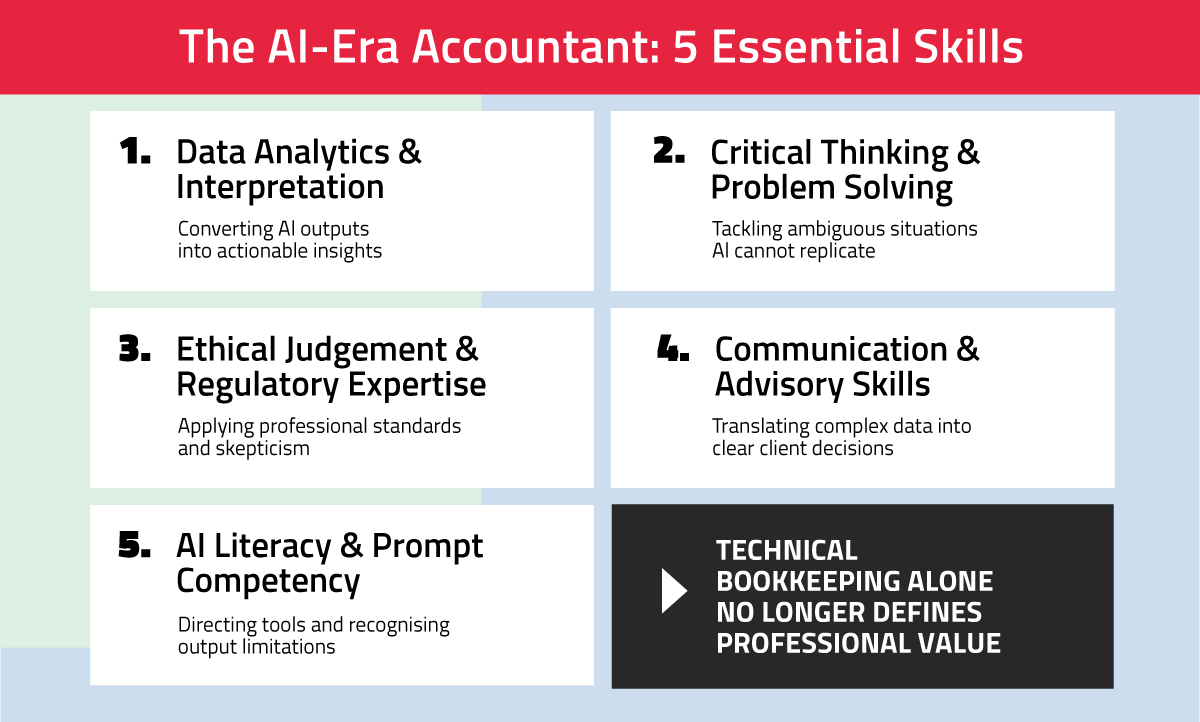
Five competencies are particularly important.
-
Data analytics and interpretation: Converting AI-generated outputs into insights that businesses and clients can use.
- AI literacy: Using AI tools effectively, writing clear prompts, understanding their limitations, and recognising when outputs require further review.
- Critical thinking and complex problem-solving: Assessing assumptions, identifying inconsistencies, and resolving financial issues that cannot be handled reliably through automation alone.
- Communication and advisory skills: Explaining complex financial information clearly and translating analysis into practical recommendations.
- Ethical judgement and regulatory expertise: Applying professional standards when AI-generated outputs are incomplete, inaccurate, biased, or inappropriate.
Professional judgement is becoming increasingly important in AI-enabled accounting. Accountants must know when to challenge an automated recommendation, verify a generated figure, and require human oversight.
As AI takes over more routine processing, the accountant’s value shifts from producing financial information to interpreting it, testing its reliability, and advising others on what action to take.
Students planning to become an accountant should therefore build both core accounting knowledge and the digital, analytical, and advisory skills increasingly required in AI-enabled firms.
Why is upskilling and continuous learning important for an AI-driven accounting career?
Upskilling and continuous learning is one of the most practical ways accountants can respond to AI-driven changes in the profession. As routine work becomes more automated, employers increasingly value professionals who combine accounting knowledge with technological literacy, analytical thinking, adaptability, and advisory capability.
The World Economic Forum’s "Future of Jobs Report 2025" identifies several skills expected to grow in importance across financial services between 2025 and 2030, including:
- AI and big data.
- Technological literacy.
- Networks and cybersecurity.
- Analytical thinking.
- Resilience, flexibility, and agility.
Research from CPA Trendlines also indicates that many accounting professionals view generative AI and wider technology capability as significant skills gaps within the profession.
Four areas are particularly important for accountants to develop.
- AI literacy: Using AI tools effectively, understanding their limitations, and recognising when human verification is required.
- Data analytics and visualisation: Turning financial data into clear insights that clients, managers, and stakeholders can act on.
- Strategic advisory skills: Moving beyond reporting to interpretation, recommendation, and business decision support.
- Technology risk and cybersecurity awareness: Understanding the control, privacy, fraud, and security risks created by automated finance systems.
Large accounting firms are investing in AI training and technology-enabled professional development. Professional bodies like ICAEW relaunched the ACA qualification in 2025 with updated modules on ethics, technology, and sustainability. ACCA encourages proactive AI embrace with the view that human insights are still required.
For students and career changers, practical preparation should include:
- Choosing courses with data analytics and accounting-technology modules.
- Building experience with AI-enabled accounting and reporting tools.
- Developing financial modelling and forecasting skills.
- Strengthening communication and advisory capability.
- Learning how to verify AI-generated outputs.
- Understanding data protection, ethics, and professional accountability.
Graduates who develop these capabilities before entering the profession may be better prepared for firms where formal AI training, governance, and policies are still developing.
Upskilling therefore serves two purposes: it reduces exposure to routine-task automation and improves access to advisory, analytical, technology-risk, and strategic finance roles.
How Accounting Firms and the Industry Are Adapting to AI?
Accounting firms are adapting to AI by investing in new platforms, redesigning workflows, changing recruitment priorities, and moving more professional time towards analysis, advisory work, and technology-enabled assurance.
Large accounting firms are integrating AI into audit, tax, reporting, research, and client service functions. PwC's partnership with OpenAI gives 100,000+ staff access to GPT-4 tools and next-generation audit platforms, EY's AI Agentic Platform embeds 150+ specialised tax agents supporting 80,000 professionals worldwide, and KPMG's Workbench creates a multi-agent collaboration environment mirroring human audit teams. These are strategic investments, not experiments.
Hiring priorities are shifting accordingly as accounting firms now seek accountants with both financial expertise and technological adaptability. Graduate roles are being redesigned, less manual processing, more AI-augmented analysis from day one. The technology is no longer viewed as a specialised add-on; it's a core professional competency expected of all qualified accountants.
The day-to-day experience of working in accounting is changing as a result. Less time spent on data entry and reconciliation while more time on client advisory, analysis, and strategic work.
The accounting industry's adaptation to AI also serves as a model for career resilience more broadly. The profession has always evolved with technology, from manual ledgers, to spreadsheets, to cloud software, and now to AI. Each transition created anxiety and disruption, and each one ultimately created a stronger, more capable profession. The accountants who embraced each wave of technology outperformed those who resisted it.
Will AI replace accountants completely?
No, AI is unlikely to replace accountants completely, as there is a consensus among researchers and industry leaders on it. ACCA and ICAEW both hold human insight and professional judgement remain irreplaceable. It will automate many routine accounting tasks, but human judgement, client trust, regulatory interpretation, and professional accountability remain essential.
- Complex decision-making requires human judgment and expertise: Accounting decisions require understanding complex business transactions, regulatory frameworks, and industry nuances. AI cannot exercise human intelligence, discretion, judgment, ethics, and creativity. All the things needed to make complex accounting decisions in unique situations.
- Client relationships and trust: Building client trust and maintaining relationships are integral to the profession. Interpersonal skills, communication, and the ability to understand a client's unique financial goals and challenges are things that AI can’t replicate.
- Oversight and interpretation: Human accountants play a pivotal role in guiding businesses through financial complexities. AI can automate data entry and analysis, but it cannot reliably interpret results, provide context, or advise on strategic financial decision.
The distinction that matters for career planning separates job displacement (roles disappearing) from job transformation (roles changing substantially). Processing roles, entry-level clerical functions, and high-volume transactional work face genuine job security concerns. Advisory, analytical, and strategic accounting roles grow rather than shrink.
Why Accounting Remains a Strong Career Choice in the Age of AI?
Accounting remains a strong career choice in the age of AI because AI is changing the profession rather than eliminating it. Routine processing is becoming more automated, while demand is shifting towards advisory work, financial analysis, risk management, regulatory interpretation, and strategic decision support.
These areas still require human judgement, accountability, communication, and an understanding of complex business contexts. AI can identify patterns, produce forecasts, and accelerate reporting, but qualified accountants are needed to verify outputs, explain their implications, and recommend appropriate action.
The profession is also becoming more technology-enabled. Accountants increasingly work with AI, data analytics, automation, and digital finance tools, making the role less focused on manual processing and more focused on interpretation, problem-solving, and client advice.
Karbon’s "State of AI in Accounting 2026" report found that 91% professionals believe graduates are more likely to join firms that use AI. This suggests that early-career accountants who develop AI literacy alongside strong accounting knowledge may be better positioned in the job market. These changes are also reshaping the range of accounting and finance careers available to graduates, with growing emphasis on advisory, analysis, technology risk, and strategic finance roles.
Is an accounting degree still valuable in the age of AI?
Yes, an accounting degree remains valuable in the age of AI because it builds the financial, regulatory, analytical, and ethical knowledge needed to review AI-generated outputs and support complex business decisions.
It also provides a strong foundation for professional accountancy qualifications such as ACCA, ICAS, ICAEW, CIMA, and CIPFA, which remain important for progression into qualified and senior accounting roles.
How do accounting degrees at Edinburgh Napier University prepare you for career in AI era?
Accounting degrees at Edinburgh Napier University prepare you for career in AI era in practical ways listed below.
- The Accounting Professional module in the first year helps set the basis for later modules to build upon AI in accounting.
- Tutorial sessions provide the opportunity to engage with current research in the field and evolving professional practice. You’ll be encouraged to read widely before tutorials and engage actively in discussions around the integration between research and practice in accountancy, with the impact of AI being a recurring focus during your studies.
- Preparation for tutorials involves you undertaking independent self-study, which will help you to engage with the commercial drivers that companies are reacting to when they plan the introduction of AI tools, and the emerging skills base and insight required by early career accountants.
- Oral feedback from academic staff will help you improve your understanding and critical thinking, around AI and other key emerging issues, and be better prepared to enter the profession.
In our accounting courses, students are prepared for AI enabled careers by combining core accounting knowledge with analytical, digital, communication, and professional judgement skills. These capabilities form part of the wider benefits of studying accounting and finance, particularly as employers place greater value on adaptable graduates who can work effectively with technology.
Take the Next Step: Build Your AI-Ready Accounting Career at Edinburgh Napier University
Edinburgh Napier is ranked the number one modern UK university for Accounting and Finance in the Good University Guide 2025. Its BA (Hons) Accounting and BA (Hons) Accounting with Corporate Finance programmes are accredited by major UK professional bodies including ACCA, ICAS, CIPFA, ICAEW, and CIMA, with exam exemptions that give you a head start on qualification. Both programmes are built around the practical, industry-relevant skills that employers in an AI-influenced accounting profession are actively looking for.
The university is based in Edinburgh, one of the UK's leading financial centres, giving you access to a professional network and placement opportunities that genuinely shape careers. From financial services to corporate finance to strategic advisory, the career paths open to Edinburgh Napier graduates are broad and well-supported.
Ready to start building your future-proof accounting career? Explore undergraduate and postgraduate accounting programmes at Edinburgh Napier University and take the first step toward a career that's ready for everything AI will bring.