
A financial adviser is a regulated professional who helps individuals, families, and businesses make decisions about investments, pensions, insurance, tax, estate planning, and long-term financial security. In the UK, financial advisers must meet Financial Conduct Authority requirements, hold a recognised Level 4 qualification such as the Diploma in Regulated Financial Planning or the Diploma in Financial Advice, maintain an annual Statement of Professional Standing, and work independently or within an FCA-authorised firm.
There are several routes into the profession. Students can begin with a relevant degree in financial services, accounting and finance, economics, or business, then progress through professional qualifications from Level 3 to Level 4 and, later, Level 6 for Chartered Financial Planner status. Others enter through apprenticeships, paraplanning, financial services administration, or direct professional study. Career progression usually moves from administrator or paraplanner to trainee adviser, qualified adviser, senior adviser, and eventually director, partner, or self-employed independent financial adviser.
Demand for financial advisers is supported by the UK advice gap, pension auto-enrolment, rising retirement complexity, and the need for personalised human advice. AI and robo-advice can support administration, portfolio analysis, report drafting, and research, but FCA-regulated personalised advice still requires human accountability, suitability assessment, ethical judgement, and client trust. This makes financial advice a strong career option for students who combine technical financial knowledge with communication, relationship management, compliance awareness, and commercial judgement.
Edinburgh Napier University offers routes into the profession through BA (Hons) Financial Services, BA (Hons) Accounting with Corporate Finance, MSc Accounting, and MSc International Finance. Based in Edinburgh, one of the UK’s major financial centres, the university connects students with career-focused learning, professional networks, placement opportunities, and pathways into financial advice, wealth management, banking, accounting, and wider financial services.
What is a Financial Adviser?
A financial advisor is a regulated professional who evaluates a client's financial position and provides structured guidance on managing, growing, and protecting personal or business wealth. As a financial adviser you help individuals and businesses manage money, plan investments, reduce risks, and achieve long-term financial goals like retirement, tax efficiency, and wealth growth.
All financial advisers in the UK must be authorised by the Financial Conduct Authority (FCA) or work within an FCA-regulated firm. Every practising financial advisor in the UK holds a minimum Level 4 RQF qualification such as Diploma for Financial Advisers (DipFA), the Diploma in Regulated Financial Planning (DipPFS), or the Certificate in Financial Planning. It maintains an annual Statement of Professional Standing (SPS) from a recognised professional body, and operates independently or under a FCA authorised firm.
What does a financial adviser do?
Financial advisers assess client financial circumstances, identify financial objectives, and construct regulated advice plans across 5 core areas listed below.
- Investment planning advisers evaluate a client's risk tolerance, time horizon, and financial goals to recommend suitable asset allocations across vehicles such as ISAs, unit trusts, and general investment accounts.
- Pension and retirement planning advisers analyse existing pension provisions including workplace, personal, defined benefit schemes, and project retirement income against the client's target lifestyle.
- Insurance and protection advisers assess income, life, and critical illness risk and recommend cover levels calibrated to the client's financial obligations.
- Tax efficiency advisers identify allowable reliefs and tax-advantaged wrappers to reduce the client's overall liability within HMRC rules.
- Estate and inheritance planning advisers structure wealth transfer strategies including wills, trusts, and gifting plans to mitigate Inheritance Tax exposure and align with the client's legacy objectives.
Day-to-day role involves managing client relationships, following a structured advice process when working through a client's needs, constructing tailored financial plans, ensuring ongoing compliance with FCA rules, and committing to continuous professional development. It's a role that combines technical expertise with genuine human connection , and that balance is a big part of what makes it so compelling.
What types of financial advisers are there in the UK?
There are two types of financial advisers in the UK as classified by FCA: independent financial advisers (IFAs) and restricted advisers.
- Independent financial advisers (IFAs) also known as “independent advisers” assess the whole of the market. An independent adviser considers all regulated financial products available for a given client need including ISAs, pensions, and investment funds and selects the most suitable option without restriction to any provider or product range. IFAs serve clients with complex, multi-area financial needs and hold the broadest advisory scope under FCA rules.
- Restricted advisers provide financial advice within a defined scope. A restricted adviser recommends products from a specific provider's range or within a defined product category, such as pensions only. Restricted status carries the same Level 4 qualification requirement as IFA status, the restriction applies to product scope, not professional competence.
The financial advisers in the UK specialise across 4 regulated roles listed below.
- Wealth managers advise high-net-worth individuals (HNWIs) across integrated investment, tax structuring, and estate planning strategies, typically for clients with investable assets above £500,000.
- Mortgage advisers operate under FCA MCOB (Mortgages and Home Finance: Conduct of Business) rules, which govern how advisers recommend residential and buy-to-let mortgage products and remortgage strategies.
- Pension transfer specialists hold the CII AF3 Pension Transfer qualification which enables them to advise on defined benefit pension transfer cases, which carry additional FCA regulatory protections.
- Discretionary fund managers (DFMs) manage client investment portfolios under a discretionary mandate, a formal agreement that authorises them to execute trades without requiring individual client approval for each transaction.
Why become a financial adviser?
Becoming a Financial adviser offers 6 structural career advantages including earning potential, long-term demand, professional independence, client impact, career environment choice, and career resilience.
- Earning potential: Earnings for financial advisers are performance-linked at every career stage. Salaries are competitive from the early careers, with clear upward progression as you gain qualifications and experience.
Newly qualified advisers in salaried roles earn between £35,000 and £55,000. Senior chartered advisers earn between £55,000 and £90,000. Self-employed IFAs who build established client books earn above £100,000.
According to the 2026 Salary Guide by Robert Half, part-qualified roles earn an average salary between £33,000 to £43,000 while qualified roles earn between £47,000 to £56,000.
- Long-term demand: Demand for financial advisers is strong and growing across the UK. As the percentage of the population who have retired continues to grow, with current demographic trends, the focus on issues such as Inheritance Tax and Estate Planning will continue to fuel demand for professional advisers.
- Professional independence: Financial advice can provide greater professional autonomy than many traditional finance roles. Qualified IFAs establish independent practices, set fee structures aligned to their service model, and build an asset-under-advice (AUA) portfolio that generates recurring revenue through ongoing service charges.
- Client impact: Direct impact on client characterises the day-to-day nature of the work. Financial advisers guide clients through life-events like retirement planning, inheritance decisions, business succession, and divorce settlement restructuring. These events carry direct consequences for long-term financial security. Advisers working at this depth of client relationship build professional engagement that transactional finance roles structurally cannot replicate.
- Career environment choice: Career environments for financial advisers spans private banks, wealth management firms, insurance companies, national advice networks, and independent practices, including self-employment. This variety allows advisers to choose between structured employment, specialist advisory work, relationship-led wealth management, or independent practice.
- Career Resilience: The career of financial advisers is underpinned by structural protections. FCA's regulatory barrier to entry filters out unqualified entrants, the relational and ethical complexity of the role resists automation, and the ongoing CPD requirement sustains professional relevance across a full career lifespan.
Financial adviser is one of several accounting and finance careers that combine technical financial knowledge with client-facing, commercial and advisory work.
What qualifications do you need to become a financial adviser in the UK?
To become a financial adviser in the UK, FCA mandates a minimum Level 4 qualification on the Regulated Qualifications Framework (RQF) for all financial advisors providing personalised investment advice to retail clients in the UK.
The principal Level 4 qualification is the Diploma in Regulated Financial Planning (DipPFS), awarded by the Chartered Insurance Institute (CII). The equivalent qualification from the London Institute of Banking and Finance (LIBF) is the Diploma in Financial Advice (DipFA).
Alongside the Level 4 qualification, advisers must hold FCA authorisation either directly or as an Appointed Representative (AR) of an FCA-authorised firm, and renew an annual Statement of Professional Standing (SPS) confirming 35 hours of continuing professional development (CPD) per year.
The full qualification pathway spans 3 levels as listed below.
- Level 3 - Certificate in Financial Planning (CertPFS, CII) or Certificate for Financial Advisers (CeFA, LIBF): Covers financial services regulation, investment fundamentals, and protection products. The entry-level qualification for roles in financial services support and paraplanning.
- Level 4 - Diploma in Regulated Financial Planning (DipPFS, CII) or Diploma for Financial Advisers (DipFA, LIBF):The FCA minimum for advising on retail investment products, pensions, and protection. Completion of this qualification triggers eligibility for FCA registration.
- Level 6 - Advanced Diploma in Financial Planning (APFS, CII):The foundation for Chartered Financial Planner status, the highest professional designation in UK financial advising, awarded by the CII after 5 years of post-qualification experience.
The CERTIFIED FINANCIAL PLANNER designation, administered in the UK by the Chartered Institute of Securities and Investment (CISI) and recognised across 27 countries, requires Level 4 Investment Advice Diploma (IAD) qualification completion plus a structured CFP examination programme covering financial planning across 6 domains: financial management, asset management, risk management, tax planning, retirement planning, and estate planning.
How to become a financial adviser with a university degree?
To become a financial advisor with a university degree, you complete a relevant undergraduate programme in accounting, finance, economics, or financial services, then progress to Level 4 CII, LIBF, or CISI qualifications.
Accounting and finance degree programmes cover modules like investment theory, financial management, taxation, planning personal finance, and risk management. These subject areas develop the required knowledge and skills to be prepared for Level 4 qualification, and give competitive edge to relevant degree holders over non-degree candidates.
Graduates from degree programmes accredited by ACCA, CIMA, or CISI gain formal exemptions from specific CII examination units. Some accounting programmes at Edinburgh Napier University's such as BA (Hons) Financial Services, BA (Hons) Accounting with Corporate Finance graduates can help you claim 25 Non-Unit specific credits at Diploma level in Financial Services, and 30 Non-Unit specific credits at Advanced Diploma level in Financial Services CII. (Please check your CII exemption eligibility)
How to become a financial adviser without a degree?
To become a financial advisor without a degree, you enter the profession through an apprenticeship or by taking the Level 4 professional qualification directly after secondary education. The FCA does not require a university degree as a precondition for individual authorisation.
The non-degree route takes 3 to 5 years from Level 3 commencement to FCA-authorised practitioner status. The degree route takes 4 to 6 years including undergraduate study. The non-degree route suits career changers from accounting, banking, or insurance backgrounds, and school leavers entering financial services through administrator or paraplanner roles with employer-funded qualification support.
What skills do you need to become a financial adviser?
To become a financial adviser, you need a combination of skills across 3 categories, that is, analytical and technical skills, interpersonal and communication skills, and regulatory and commercial skills.
Analytical and Technical Skills
These are the analytical and technical skills you need to become a financial adviser.
- Accounting and economics knowledge: Understanding core accounting principles and economic concepts provides the foundation for interpreting financial data, modelling client scenarios, and assessing how broader market conditions affect individual financial plans.
- Financial analysis: Interpreting balance sheets, investment performance data, pension valuations, and tax calculations to construct accurate client financial profiles.
- Risk assessment: Evaluating risk tolerance, capacity for loss, and investment time horizons to match suitable products to each client's circumstances.
- Quantitative reasoning: Performing present value, compound interest, portfolio return, and cash flow modelling calculations to support financial planning recommendations.
- Product knowledge: Understanding investments, pensions, protection, mortgages, and tax planning well enough to know what is available and when each is appropriate for a given client situation.
- Software proficiency: Competence in financial planning and cash flow modelling tools such as Voyant or Truth, along with wrap platforms and back office systems, is increasingly expected from early in your career.
Interpersonal and Communication Skills
These are the interpersonal and communication skills you need to become a financial adviser.
- Active listening: Clients rarely articulate their financial goals in precise terms. Advisers identify unstated concerns and extract accurate client intent through structured questioning, not only client words. This skill distinguishes competent advisers from technically qualified ones.
- Clear communication: Explaining complex financial concepts, regulatory requirements, and product terms to clients without financial backgrounds. Verbal communication applies in client meetings; written communication applies in suitability reports, which are legal documents that must meet FCA standards for clarity and completeness.
- Relationship management: Building and sustaining long-term trust with clients across extended service relationships, often spanning multiple decades and life events.
- Ethics: FCA requires advisers to act in their clients' best interests at all times. Ethical judgement. Knowing what is right, not just what is technically permissible is a core professional priority throughout your career.
Regulatory and Commercial Skills
These are the regulatory and commercial skills you need to become a financial adviser.
- Compliance awareness: Applying FCA conduct of business rules, anti-money laundering procedures, and Consumer Duty suitability standards to each client engagement.
- Business development: Attracting, retaining, and growing a client base through professional referral networks, digital presence, and client advocacy to build a sustainable advisory practice.
Emerging Skills
According to the World Economic Forum's 2025 Future of Jobs Report, employers in financial services are increasing their demand for five skills between 2025 and 2030: AI and big data, networks and cybersecurity, technological literacy, resilience and agility, and analytical thinking.
What is the salary of a financial adviser in the UK?
Salaries of financial advisers in the UK range from £22,000 at trainee level to over £150,000 for established self-employed IFA principals.
According to 2025 Job Profile of Financial Adviser by Prospects, annual salary for a financial advisor ranges between £22,500 to more than £100,000 based on career stage.
- Salaries at administrative level range from £22,500 to £35,000.
- Junior financial advisers can earn between £30,000 and £45,000.
- Senior financial advisers can earn between £55,000 to £100,000.
- Wealth managers or private client advisers may earn more than £100,000.
According to 2026 Salaries by Indeed, average salaries of a financial adviser in Scotland are listed below.
- Paraplanners can earn between £25,000 to £35,000.
- Entry level financial advisers earn an average salary of £36,000.
- Junior financial advisers earn an average salary of £40,000.
- Senior financial advisers earn between £45,000 to £75,000.
What is the demand for financial advisers in the UK?
The demand for financial advisers is growing in the UK is supported by an ageing population, changing pension rules, a large financial advice gap, and growing complexity of retirement and investment decisions.
According to Mintel's Consumers and Financial Advice UK 2026 report, 72% of UK adults need financial advice for investment, pensions and retirement planning, under-50s want help with mortgages and buying property, and 45-63 year olds need advice on decumulation options.
The World Economic Forum's Future of Jobs Report 2025 also predicts growth in financial and investment adviser roles between 2025 and 2030. Financial advisers with expertise in strategic planning, financial system modernisation, and emerging technology implementation are particularly well-positioned for this growth.
In the UK, demand is strongest in areas such as retirement planning, pensions, investments, and wealth management. Opportunities are concentrated in financial centres including London, Edinburgh, Manchester, and Leeds, although financial adviser roles are available across the country.
What is the career pathway for a financial adviser?
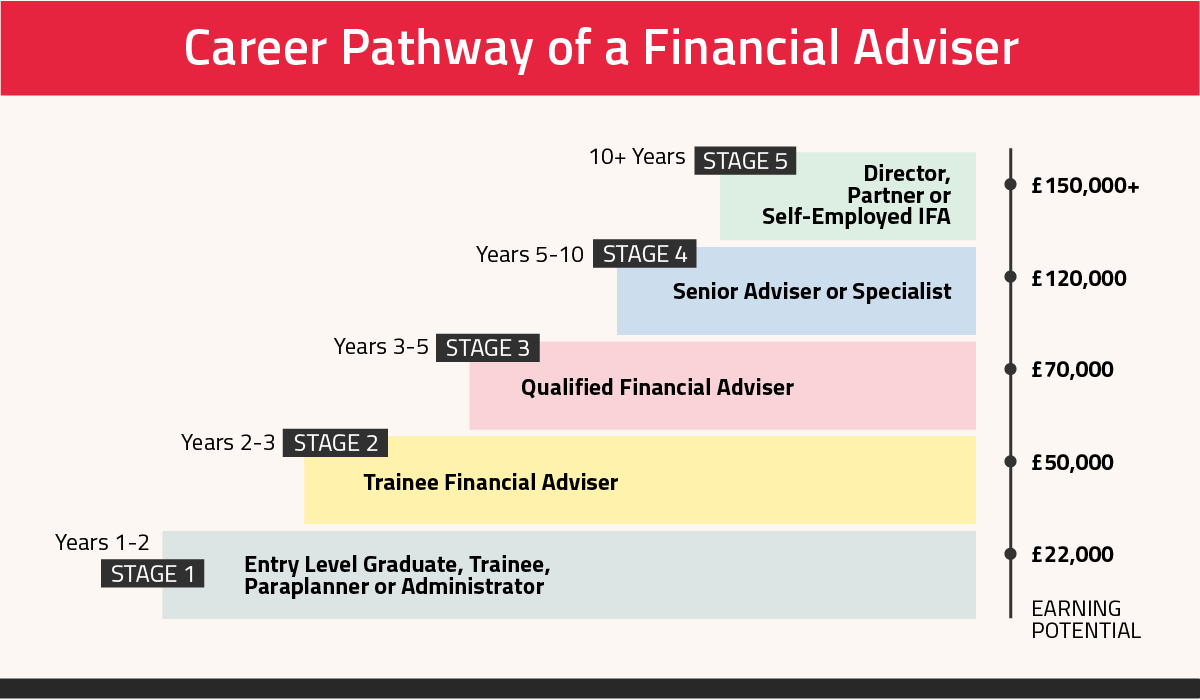
The financial advisor career pathway follows 5 structured stages from entry-level support roles to senior practitioner and practice leadership.
Stage 1: Entry Level Graduate Trainee, Paraplanner, or Administrator (Years 1–2)
Financial advisory careers typically begin in paraplanning or administration. Paraplanners support qualified advisers by preparing suitability reports, conducting fund research, and managing client review processes.
Stage 2: Trainee Financial Adviser (Years 2–3)
Trainee financial advisers hold CII Level 3 qualifications and operate under the direct supervision of a qualified and FCA-registered adviser. FCA competence requirements mandate a supervised practice period typically 12 to 24 months before an adviser achieves independent "competent adviser" status. Trainees conduct supervised client meetings and develop financial planning skills under structured mentorship programmes.
Stage 3: Qualified Financial Adviser (Years 3–5)
Qualified financial advisers hold a Level 4 Diploma in Financial Planning, hold FCA authorisation as a directly authorised firm or Appointed Representative, and manage an independent client book.
Stage 4: Senior Adviser or Specialist (Years 5–10)
Senior advisers develop specialist expertise in 1 or more areas, such as defined benefit pension transfer advice, inheritance tax planning, or corporate benefits strategy. Chartered Financial Planner status requiring the CII Level 6 Advanced Diploma and 5 years of post-qualification experience is typically achieved at this stage.
Stage 5: Director, Partner, or Self-Employed IFA (10+ Years)
Experienced advisers establish independent practices, become equity partners in established advisory firms, or take directorial roles in wealth management businesses. Income at this stage reflects the adviser's AUA (assets under administration) and client retention rate rather than a fixed salary.
Is a Career as a Financial Adviser the Right Fit for You?
Yes, a career as a financial adviser is the right fit for you if you have numerical competence with strong interpersonal skills, a preference for long-term client relationships, and a commitment to sustained professional qualification.
Three professional profiles align most closely with long-term financial advising careers.
- The relationship-oriented analyst: an individual who applies financial knowledge to solve real client problems, who builds professional trust naturally, and who prefers advisory and consultative work over transaction processing, reporting, or portfolio management.
- The entrepreneurially minded professional: an individual who seeks the financial upside of practice ownership and accepts the commercial responsibility of building, managing, and retaining a client base over a multi-decade career.
- The career changer with finance sector experience: a professional transitioning from accounting, banking, insurance, or mortgage brokering who carries transferable financial knowledge and seeks a higher-contact, higher-autonomy client role than their current function provides.
Financial advising is less suited to individuals who prefer research-only or back-office positions, who have strong aversion to regulatory compliance demands, or who require high immediate earnings before completing a multi-year qualification pathway.
Will AI replace financial advisers?
No, AI will not replace financial advisors in the UK because the FCA regulatory framework assigns legal accountability for personalised advice to a qualified, registered human adviser. The FCA's suitability rules require that every advice record carries the responsibility of a named, FCA-authorised individual. AI in financial advice is more likely to change administrative, analytical, and reporting tasks than replace the regulated human adviser.
Automated tools including robo-advisers such as Wealthify, and Moneyfarm hold separate FCA authorisations under a restricted, non-personalised service model that sits outside the scope of full regulated advice. Robo-advisers manage assets algorithmically but do not produce the personalised suitability reports that FCA-regulated financial advice requires.
AI augments financial advising in 3 specific functions: portfolio analysis and automated rebalancing (tools such as Morningstar Direct and FactSet), suitability report drafting assistance using language model tools, and client data aggregation across financial accounts and pension records. A 2023 survey by Intelliflo found that AI-assisted tools reduce adviser administrative time by approximately 30%. This time reduction benefits client-facing work rather than reducing the need for advisers.
The FCA's 2023 Artificial Intelligence and Machine Learning Discussion Paper classified AI tools operating in UK financial services as decision-support tools, not decision-makers, under current regulatory policy. The human dimensions of financial advising like emotional intelligence in retirement conversations, ethical judgement in conflicts of interest, long-term trust relationships, and regulatory accountability under Consumer Duty represent irreplaceable elements that AI tools cannot perform within the FCA's current framework.
What are the best undergraduate degrees to become a financial adviser?
The best undergraduate degrees to become a financial advisor in the UK are Accounting, Accounting with Corporate Finance, Financial Services, or Business Management.
Accounting and finance degrees provide the most direct entry path because these programmes develop knowledge and skills required to start an early career as a financial adviser.
Financial Services course is specifically designed to align with industry needs, typically incorporating modules on regulation, compliance, ethics, and the advice process. Probably the closest course alignment to the day-to-day realities of an adviser's work.
Business management degrees develop broad commercial awareness without the technical financial depth that shortens the post-graduation qualification pathway.
An accounting and finance degree provides career optionality. Graduates who enter financial advising after periods in audit, tax, corporate finance, or banking carry professional experience that strengthens client credibility, satisfies FCA competence assessment criteria more rapidly, and supports faster progression through the career pathway stages. These pathways also reflect the wider benefits of studying accounting and finance, including career flexibility, professional progression, financial literacy, and access to roles across financial services
Why study Financial services degree at Edinburgh Napier University?
Edinburgh Napier University's BA (Hons) Financial Services provides the academic foundation and work placement that accelerate the financial advisory qualification pathway. Edinburgh Napier University is currently the only university in Scotland to offer an undergraduate degree in financial services. It gives our graduates a competitive edge in the financial sector in Scotland.
The programme covers core modules including investment management, regulatory risk management, planning personal finance, investment and portfolio planning, and financial technology. These modules develop your knowledge in key areas important for current market needs and further qualification.
The financial services course offers 6 months (24 weeks) of paid work experience opportunity within the financial services sector. Students who complete a work placement at a financial services firm enter the graduate job market with supervised industry experience, which many employers treat as equivalent to the early paraplanner stage. Edinburgh Napier's industry partnerships and placement programme connects students with Edinburgh's financial services sector through employer partnerships, guest lectures from practicing financial advisors and chartered wealth managers, and structured work placement opportunities embedded within the degree.
Explore Your Path to Becoming a Financial Adviser with Edinburgh Napier University
If this career path resonates with you, we'd encourage you to take a closer look at what Edinburgh Napier University has to offer. With programmes including BA (Hons) Accounting, BA (Hons) Financial Services, BA (Hons) Accounting with Corporate Finance, MSc Accounting, and MSc International Finance, Edinburgh Napier offers a range of undergraduate and postgraduate routes into the financial services profession.
As a top 10 UK modern university for Accounting and Finance, based in one of Europe's leading financial centres, Edinburgh Napier gives you direct access to industry employers, networking opportunities, and a curriculum designed with real-world financial advice careers in mind.
Ready to take the next step?
- Explore undergraduate accounting and finance courses at Edinburgh Napier
- Apply for a postgraduate programme in accounting, finance, or international finance
- Attend an open day to see the campus and meet the team in person
- Contact the admissions team for more information on entry requirements, professional exemptions, and course content
Your career in financial advice can start here.